
 Yoga & Meditation
How to meditate for beginners is simpler than most people think: sit comfortably, close your eyes, and focus on your breath for 5 minutes. Research from Harvard Medical School shows that just 8 weeks of consistent meditation physically changes areas of the brain linked to focus and stress. You don’t need an app, a cushion, or any experience. If you can breathe, you can do this.
You sat down, closed your eyes, and tried. Then your brain immediately started running through your grocery list, that thing you said at work three years ago, and whether you left the stove on. After two minutes, you quietly gave up and decided you just weren’t someone who could meditate. Sound familiar?
Here’s the thing — that experience is practically a rite of passage. Meditation for beginners almost always starts exactly like that. And the beginners who stick with it aren’t the ones whose minds went quiet. They’re the ones who learned what meditation actually is — because nobody told them the truth upfront.
This guide is here to fix that. By the time you finish reading, you’ll know exactly what meditation is (and isn’t), how to start meditation for beginners in the next 5 minutes, 5 techniques that actually work for real people with real monkey-brain thoughts, and — most importantly — what to do when your mind wanders so you don’t quit. This isn’t written for Zen monks. It was written for you.
Let’s start from the very beginning.
What Is Meditation, Really?
Meditation is not about emptying your mind. Let that go right now, because that belief alone has caused more people to quit than anything else.
Think of it this way: meditation is more like a gym workout for your attention. You’re not trying to stop thoughts from arising — that’s like trying to stop waves in the ocean. Instead, you’re practicing the act of noticing where your attention goes, and gently bringing it back to where you want it. That’s the whole practice. That’s it.
Mindfulness meditation for beginners, in particular, is simply the practice of paying attention to the present moment without judging what you find there. Your breath moves in. Your breath moves out. Your mind drifts to your inbox. You notice. You return. One rep complete.
The science on this is worth knowing. A landmark study published in JAMA Internal Medicine found that mindfulness meditation programs showed moderate improvement in anxiety, depression, and pain after 8 weeks of practice — across 47 separate clinical trials. (Source: JAMA Internal Medicine, 2014.) That’s not a wellness trend. That’s rigorous evidence.
Meditation is a skill, not a gift. Nobody is born good at it. Like learning to ride a bike, it feels awkward and effortful at first — and then one day, something clicks.
How to Start Meditation for Beginners: Your First 5 Minutes
You don’t need a special room, a subscription, or even silence. Here’s exactly how to do your first session right now.
Step 1: Find a spot.
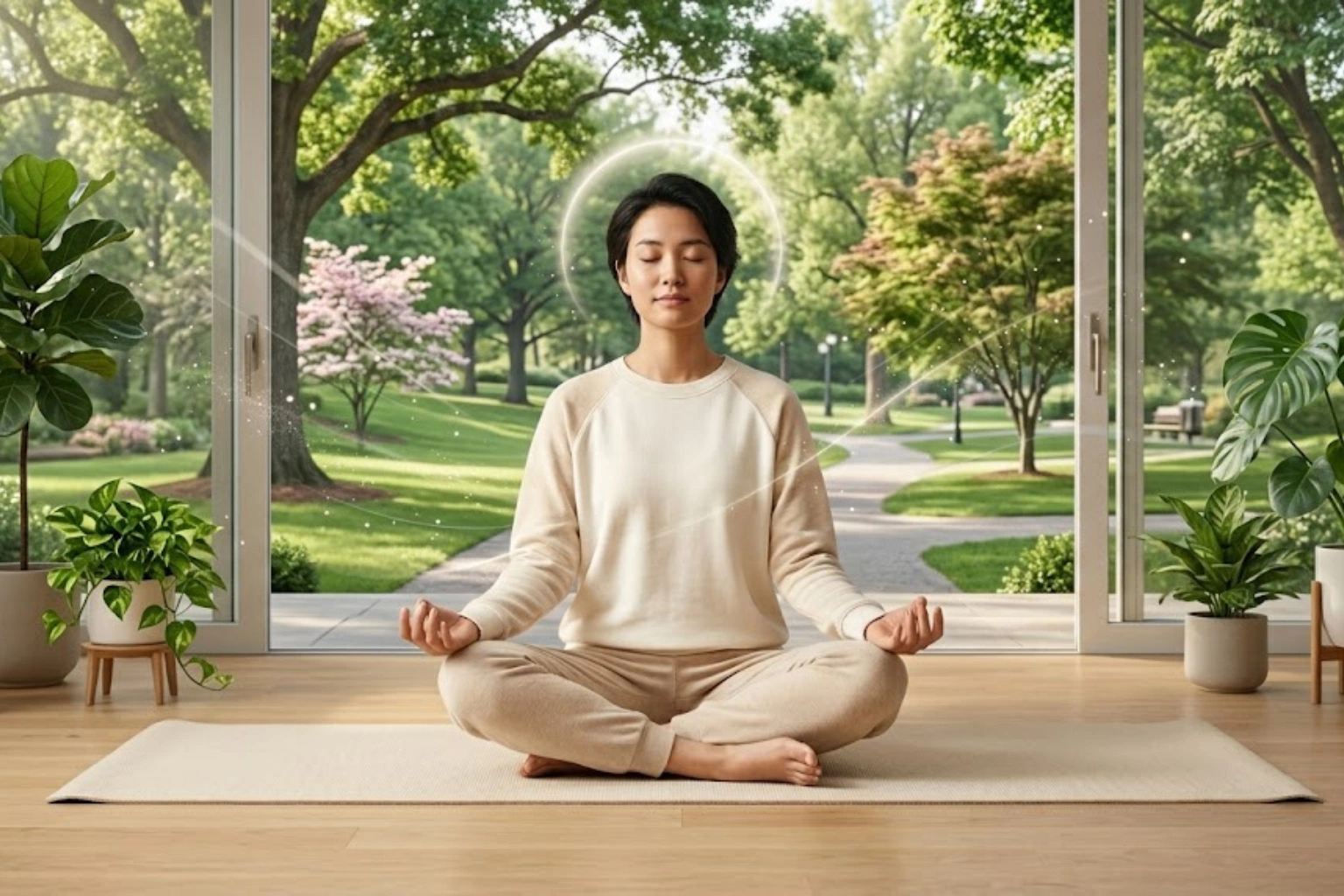
Sit somewhere you won’t be interrupted for 5 minutes. A chair, your couch, even the floor with your back against a wall. The only rule is that you’re upright enough to stay alert. Slumping sends your body a “nap time” signal, and that’s not what we’re going for here.
Step 2: Choose your position — and yes, the bed counts.
Sit with your feet flat on the floor if you’re in a chair, or cross-legged if you’re on the floor. If you’re wondering how to meditate in bed for beginners, the answer is: go for it. Lying flat on your back with your arms slightly away from your body works fine, especially when you’re just getting started. The goal is sustainable comfort, not a yoga pose.
Step 3: Set a timer.
Use your phone — 5 minutes. Put it face-down after you start. The timer removes the urge to peek at the clock, which will kill your focus every single time.
Step 4: Settle your hands.
Rest them on your thighs, palms down for a grounded feeling or palms up if you prefer. Don’t overthink this. Your hands just need somewhere to be.
Step 5: Begin breathing — and do nothing else.
Close your eyes. Take one slow breath in through your nose, and exhale fully through your mouth. Then let your breathing return to its natural rhythm. Now just notice it. Notice the cool air entering. Notice the slight rise of your chest. Notice the pause between the inhale and exhale. When your attention drifts — and it will — just return to the breath. That’s the session.
How Do You Meditate for Beginners Without Any Experience?
You meditate as a beginner by sitting comfortably, setting a 5-minute timer, closing your eyes, and focusing on each breath as it moves in and out. Each time your mind wanders, gently return your attention to your breath without judgment. That single act of returning, done repeatedly, is what builds the skill. No experience required.
American Psychological Association — Mindfulness
American Psychological Association research-backed overview of mindfulness — covers how it reduces stress and improves mental health. Use this when linking the science of mindfulness to real psychological outcomes. Highly trusted by Google for health content.
5 Meditation Techniques for Beginners
Different approaches work for different people. If one doesn’t click, try another. Here are five meditation techniques for beginners, ordered from simplest to most movement-friendly.
Breath Awareness Meditation
What it is: The most fundamental technique in existence — you simply rest your attention on your breath and keep returning to it whenever your mind wanders.
How to do it:
- Sit comfortably with your eyes closed.
- Breathe naturally — don’t control it, just observe it.
- Pick one anchor point: the feeling of air at your nostrils, the rise of your chest, or the expansion of your belly.
- Each time your mind wanders (when, not if), gently return to that anchor.
- When the timer goes off, open your eyes slowly and sit for a moment before jumping up.
Why it works for beginners: There’s nothing to memorize, no technique to get wrong. Your breath is always with you, always in the present moment. It’s the ultimate built-in anchor.
Best for: Absolute beginners who want the simplest possible starting point and zero learning curve.
Guided Meditation for Beginners
What it is: Someone else — a teacher’s recorded voice — leads you through the session. You follow along, and your only job is to listen.
How to do it:
- Download a free app: Insight Timer has thousands of free sessions; Headspace and Calm both offer free trials with excellent beginner courses.
- Search for “5-minute guided meditation for beginners.”
- Put in earbuds, close your eyes, and follow the voice.
- Don’t rate the session while it’s happening — just stay with it.
- After it ends, sit in silence for 30 seconds before opening your eyes.
Why it works for beginners: Having a voice to follow removes the “am I doing this right?” anxiety completely. You can’t get lost. Guided meditation for beginners is especially useful in the first two to four weeks, before you’ve built the self-directed focus to go it alone.
Best for: Anyone who feels anxious about “doing it wrong” or who has a very active mind that needs an external anchor.
Body Scan Meditation
What it is: A technique where you slowly move your attention through different parts of your body, from your toes to the top of your head, noticing any tension, sensation, or discomfort without trying to change it.
How to do it:
- Lie down or sit in a comfortable position and close your eyes.
- Take three slow breaths to settle in.
- Bring your attention to the soles of your feet. Notice any sensation — warmth, pressure, tingling. Don’t force anything.
- Slowly move your attention upward: feet → calves → knees → thighs → hips → lower back → stomach → chest → shoulders → arms → hands → neck → face.
- Spend 10–15 seconds on each area. When you reach the top of your head, rest in whole-body awareness for a moment before opening your eyes.
Why it works for beginners: The structured path gives your mind something specific to do, which makes it easier to stay present than open-ended breath focus. It also releases physical tension most people don’t even realize they’re carrying.
Best for: People who carry tension in their body, have trouble sleeping, or want a meditation they can do lying in bed at night.
What Is the Easiest Form of Meditation for Beginners?
The easiest form of meditation for beginners is breath awareness meditation — you focus on the natural rhythm of your breath and gently return your attention each time it drifts. It requires no equipment, no training, and no specific position. Most beginners can do it in under 5 minutes, starting on their very first attempt.
Mindfulness Meditation for Beginners — The 5-4-3-2-1 Grounding Method
What it is: A sensory-grounding technique that anchors you to the present moment by systematically engaging your five senses. It works fast, takes less than 3 minutes, and is backed by decades of cognitive behavioral therapy research.
How to do it:
- Pause wherever you are. Breathe once, slowly.
- Name 5 things you can see — not interpret, just see. The color of the wall. The grain of a table.
- Name 4 things you can physically feel — your feet on the floor, the weight of your hands, the air on your forearms.
- Name 3 things you can hear — traffic outside, the hum of an appliance, your own breathing.
- Name 2 things you can smell, and 1 thing you can taste.
Why it works for beginners: This technique is perfect for people who feel too scattered to “just breathe.” It gives an overactive mind a concrete checklist to work through, which interrupts anxious thought loops and pulls attention into the body.
Best for: Anxious beginners, people who can’t stop thinking during seated meditation, or anyone who wants a mid-day stress reset that works anywhere — at a desk, in a car, before a difficult conversation.
Walking Meditation
What it is: Meditation in motion — you walk slowly and deliberately, keeping your full attention on the physical sensations of each step rather than on your destination or your thoughts.
How to do it:
- Find a quiet path — even a hallway will work. You’ll walk back and forth over the same 10–20 feet.
- Stand still for a moment. Feel your weight evenly distributed through both feet.
- Begin walking at roughly half your normal pace.
- Focus on the sensation of each step: the lifting of your heel, the forward movement of your leg, the placement of your foot, the shift of your weight.
- When your mind drifts — to thoughts, plans, what you look like — gently bring it back to the sensation of the next step.
Why it works for beginners: This technique demolishes the biggest excuse for not meditating: “I can’t sit still.” Movement is built in. The body is doing something, which gives the restless mind something tangible to focus on.
Best for: People with high energy, chronic restlessness, those who exercise regularly and prefer movement-based practices, or anyone curious about how yoga and meditation for beginners can overlap as a combined physical and mindful practice.
What to Do When Your Mind Wanders
Here’s what most beginner guides get completely wrong: they treat a wandering mind as a problem to solve.
It isn’t. Mind wandering during meditation is the practice. Every single time you notice your attention has drifted and you bring it back — that is one mental repetition. Think of it exactly like a bicep curl. You’re not failing when your mind wanders. You’re setting up the next rep.
The move is three words: Notice. Return. Gently.
That’s it. Notice you drifted. Return to your anchor — the breath, a sensation, a sound. Do it gently, without self-criticism, without sighing at yourself, without the thought “I’m so bad at this.” The gentleness is not optional. Self-criticism during meditation activates the same stress response you’re trying to calm down.
What I tell every new student is this: the number of times your mind wanders in a session has nothing to do with how good that session was. A session where you wander 40 times and return 40 times is a great session. You just did 40 reps.
Here’s what’s actually happening in your brain when you do this. Every time you notice the wandering and redirect, you’re strengthening the connection between your prefrontal cortex — the rational, executive part of your brain — and the default mode network, which is the system responsible for mind wandering and self-referential thought. With practice, you get faster at catching the drift. The gaps of focused attention get longer. Slowly, quietly, your baseline anxiety decreases.
Even 5 minutes of this practice, 5 days a week, produces measurable changes. Harvard neuroscientist Sara Lazar’s research from 2005 showed that long-term meditators had significantly greater cortical thickness in brain regions tied to attention and interoception — but gains began appearing in participants well before the meditation habit was “long-term.”
Is It Normal for Your Mind to Wander During Meditation?
Yes — mind wandering during meditation is completely normal and is actually the central mechanism of the practice. Research shows the average person’s mind wanders up to 47% of waking hours even outside meditation. Each time you notice and return your focus, you’re completing one training repetition. It happens to experienced meditators too, every single session.
What the Research Says
Two studies are worth knowing about before you start — not because you need science permission to sit quietly, but because understanding what’s happening makes it easier to stick with it.
Study 1 — Sara Lazar, Harvard Medical School / Massachusetts General Hospital (2005). Lazar and her team found that experienced meditators had measurably greater cortical thickness in the prefrontal cortex and the right anterior insula compared to non-meditators. These are areas linked to attention, decision-making, and awareness of your own body. What makes this finding meaningful for a complete beginner: the brain changes weren’t exclusive to people who had meditated for decades. The research suggested that consistent practice — even shorter-term — was enough to begin reshaping these regions. For someone who just wants to feel less scattered and more in control, this matters.
Study 2 — JAMA Internal Medicine meta-analysis (2014). Researchers reviewed 47 randomized clinical trials and found that mindfulness meditation programs produced moderate improvements in anxiety, depression, and pain — with effects comparable in some cases to antidepressants, without the side effects. Participants in the studies weren’t meditation experts. Most were ordinary adults dealing with ordinary stress.
Most people are surprised to find that you don’t need to believe meditation works for it to work. You just need to do it consistently.
The bottom line? Eight weeks of regular meditation practice — even 5–10 minutes a day — is enough for your brain to begin measurably changing in ways that reduce stress, improve focus, and help you sleep better.
Meditation Tips for Beginners: 4 Quick Wins
Ready to actually start? These meditation tips for beginners are things you can do today, not someday.
- Start with exactly 5 minutes — not 20. Set a timer for 5 minutes tonight and do nothing else during that time except follow the breath awareness technique from this guide. Five minutes is achievable. It builds the habit. Once the habit is there, length takes care of itself. Nobody runs a marathon on day one.
- Download a free app before you go to bed tonight. Insight Timer is completely free and has hundreds of beginner-guided sessions led by experienced teachers. Calm and Headspace offer free trials. Use guided sessions for your first two weeks — they remove every point of friction. You don’t have to figure anything out. You just press play.
- Set your practice at the same time every day. Habits attach to anchors. Morning works well — right after your alarm, before you pick up your phone. If mornings aren’t realistic, right before sleep works just as well. The time matters less than the consistency. Same time, same spot, same 5 minutes. That’s a practice.
- Stop rating your sessions as “good” or “bad.” A session where your mind wandered the entire time still counts. It still rewired your brain, just a little. If you’re interested in combining physical movement with your practice, yoga and meditation for beginners is a natural pairing — many yoga classes end with a short seated meditation, and the body awareness you build in yoga directly enhances your seated practice.
Ready to Begin?
Three things matter most: meditation is not about emptying your mind, a wandering mind is not a failure but the actual workout, and 5 minutes a day is genuinely enough to start.
Starting something new takes a quiet kind of courage — especially something as personal and unfamiliar as sitting still with your own mind. If you picked up this guide, you’re already further along than most people get.
→ Next, read: 10 Best Free Meditation Apps for Beginners in 2025 — a hands-on breakdown of every major app so you can find the one that matches how your mind works and keeps your practice going past week one.
Meditation for beginners doesn’t require perfection, a special space, or a transformed life. It requires one thing.
Set a 5-minute timer right now. That’s your entire starting point.
Elevating Your Practice: Yoga and Kedarnath Tourism
For those looking to deepen their connection between body and mind, Kedarnath tourism offers a unique opportunity to practice yoga in the heart of the Himalayas. The high-altitude serenity and spiritual heritage of the Kedarnath shrine provide a powerful backdrop for mindfulness. Many travelers now combine their pilgrimage with yoga retreats, finding that the physical challenge of the trek paired with meditative stillness creates a profound sense of clarity. Whether you are practicing simple breathwork by the Mandakini River or joining a guided group at a local ashram, the energy of this sacred landscape can turn a beginner’s practice into a life-changing experience.
FAQ: Frequently Asked Questions
How Long Should a Beginner Meditate Each Day?
Beginners should meditate for 5 minutes per day to start. Research suggests that even 5–10 minutes of daily practice produces measurable benefits after 8 weeks of consistency. Starting short removes every excuse not to do it. Once 5 minutes feels easy — usually within two to three weeks — you can add time naturally.
What Should I Think About When Meditating as a Beginner?
Beginners should not try to think about anything specific during meditation. The practice is not about filling the mind with better content — it’s about observing where attention goes and returning it to your breath. Each time you notice a thought, simply label it “thinking” and return. That single act, repeated, is the entire technique.
Is 5 Minutes of Meditation Enough for Beginners?
Five minutes of meditation is absolutely enough for a beginner — and it’s the ideal starting point. Studies tracking beginner meditators showed meaningful reductions in stress and anxiety markers after just 8 weeks of sessions as short as 5–10 minutes. Consistency beats duration every time. Five minutes daily beats one hour on Sunday.
How Do I Know If I’m Meditating Correctly?
You are meditating correctly if you are sitting quietly, focusing on your breath, and returning your attention each time it drifts. There is no perfect session and no metric to hit. If your mind wandered 30 times and you brought it back 30 times, that session was a success. The practice is the returning, not the staying.
Can I Meditate Lying Down or in Bed?
You can absolutely meditate lying down, and how to meditate in bed for beginners is one of the most practical skills you can learn. Lie flat on your back, arms slightly away from your body, and follow the breath. The main risk is falling asleep — which isn’t a failure, just a different outcome. For sleep, that’s fine. For building a focused practice, sitting upright is more effective long-term.
How Long Does It Take to Feel the Benefits of Meditation?
Most beginners feel some benefit — calmer, less reactive, slightly more focused — within 2 to 3 weeks of daily practice. Measurable brain changes, according to Sara Lazar’s 2005 Harvard research, appear after approximately 8 weeks. Anecdotally, most new meditators notice they’re sleeping better within the first week. Your results will come faster than you expect.


