
 Blog
BlogThere’s a moment, somewhere on the winding road above Agastmuni, when the Mandakini valley opens up on your left, and the snow-dusted ridgeline of the Kedar range appears in the distance. Most people have their windows rolled up and their eyes on their phones. But if you catch it — really catch it — you’ll understand why this town has been drawing pilgrims, sadhus, and wanderers for centuries.
Guptkashi sits at roughly 1,319 metres in Rudraprayag district, Uttarakhand, tucked between the roar of the Mandakini River and the ancient forests climbing toward Kedarnath. Knowing how to reach Guptkashi correctly — and which route suits your schedule, budget, and comfort level — can make the difference between an exhausting ordeal and a journey you’ll remember for years.
Which Route Should You Actually Take?
Before you look at distances, ask yourself one honest question: Are you comfortable on mountain roads after dark? Because unlike many Himalayan towns, Guptkashi has multiple viable approach routes — and the right one depends entirely on your starting point and travel style.
Most visitors arrive from one of five major cities: Delhi, Dehradun, Haridwar, Rishikesh, or Rudraprayag. Each has its own pace, scenery, and set of trade-offs. No single route is “best” in every situation — but there’s certainly a best one for you.
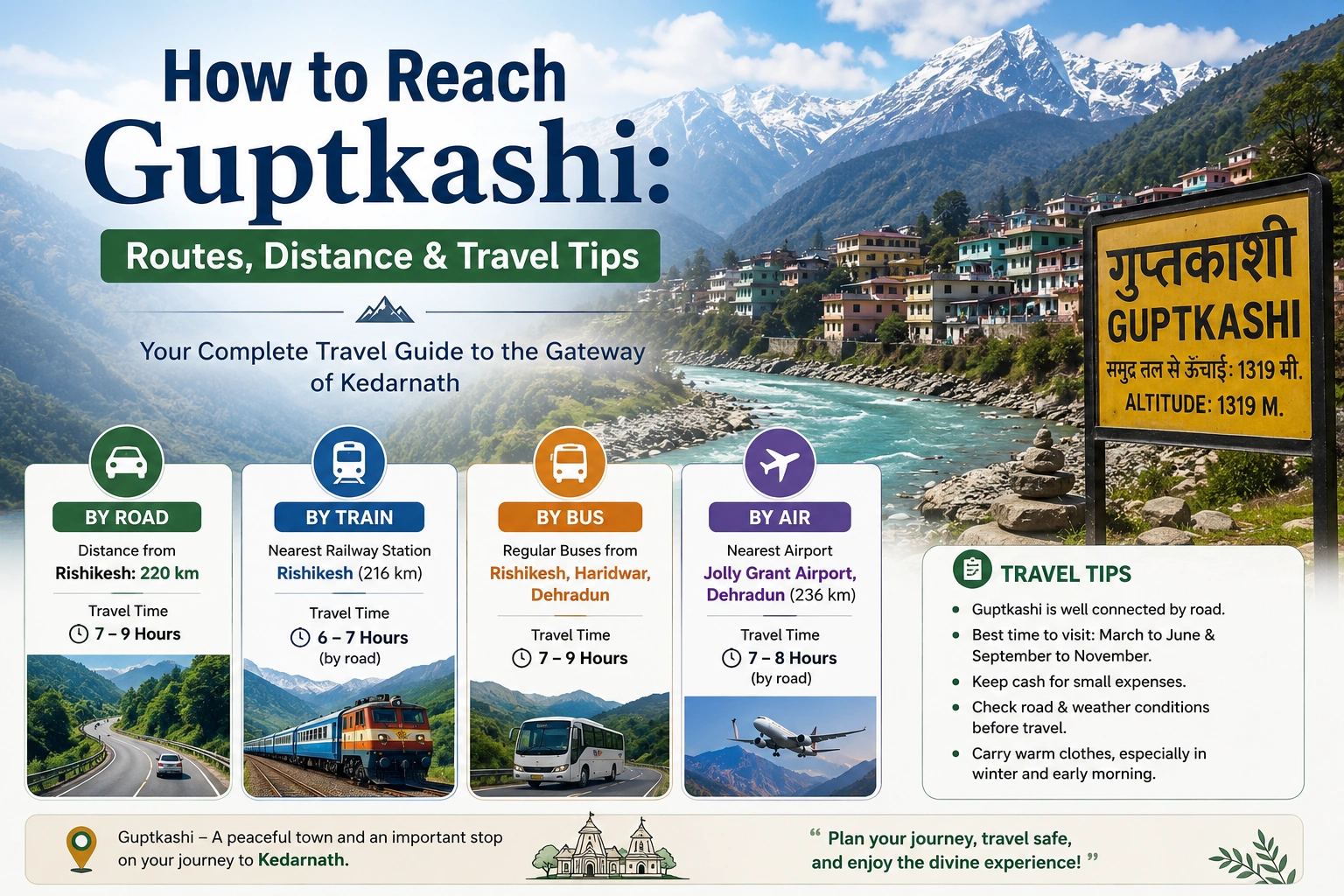
How to Reach Guptkashi by Air, Road, and Train
This is the practical core of the whole trip. Guptkashi doesn’t have its own airport, railway station, or even a direct bus service from most major cities — but that doesn’t make it hard to reach. It just means you plan in stages. Here’s exactly how each mode of transport works.
By Air — Nearest Airport to Guptkashi
The closest airport is Jolly Grant Airport in Dehradun, approximately 255–265 km from Guptkashi. It’s a small but well-connected airport, with daily flights from Delhi (about 1 hour), and less frequent connections from Mumbai, Bangalore, and Chennai — particularly during the Char Dham yatra season when demand surges and airlines add special services.
Once you land at Jolly Grant, your only real option to Guptkashi is road transport. Pre-booked taxis are the most reliable choice — most operators outside the terminal offer Jolly Grant to Guptkashi direct transfers, and the drive takes roughly 8 to 9 hours depending on traffic and weather. Expect to pay between ₹4,500 and ₹6,500 for a sedan or SUV, with prices climbing during peak pilgrimage months.
There’s no public bus from the airport to Guptkashi directly. If you want to save money, take an airport taxi to Rishikesh (about 20 km from the airport), then pick up a shared taxi or private cab from there onward. It adds some complexity but cuts costs significantly.
What most travelers miss: If you book flights for the morning and land by 10–11 a.m., you can comfortably reach Guptkashi by evening with a single straight drive and one food stop. Evening flights, however, will put you in Rishikesh after dark — and night driving into the mountains isn’t something to take lightly.
By Train — Nearest Railway Station to Guptkashi
There is no railway line into the higher Garhwal hills — the terrain simply doesn’t permit it. The two nearest and most practical railheads are Haridwar and Rishikesh, both around 200–220 km from Guptkashi.
Haridwar is the better-connected of the two. Trains from Delhi (Hazrat Nizamuddin, Old Delhi, New Delhi stations), Mumbai, Kolkata, Ahmedabad, and most major Indian cities stop here. The Jan Shatabdi, Dehradun Express, Nanda Devi Express, and Mussoorie Express are among the popular options from Delhi — travel time is roughly 4 to 5 hours, with sleeper and AC coaches available.
Rishikesh has its own station but limited connectivity compared to Haridwar. Fewer express trains stop here, and the station is a short auto-rickshaw or taxi ride from the main departure points for mountain transport. That said, if you do arrive in Rishikesh by train, the Yatri Bus Stand and the shared taxi stands near Triveni Ghat have regular departures toward Rudraprayag and Guptkashi throughout the morning.
From either railhead, the onward journey to Guptkashi takes 6 to 8 hours by road. Shared taxis from Haridwar and Rishikesh toward Rudraprayag, Ukhimath, and Guptkashi depart early morning — typically between 5 a.m. and 8 a.m. — so an overnight train from Delhi dropping you in Haridwar by 6 or 7 a.m. is genuinely one of the smartest travel combinations for this trip.
Pro Tip: Book your train ticket to Haridwar rather than Dehradun if Guptkashi is your goal. Haridwar sits directly on the main route up the valley, whereas Dehradun requires a slight detour back toward Rishikesh before you head into the hills. Saves you 45 minutes to an hour on an already long day.
By Road — Driving or Taking a Bus to Guptkashi
Road is, without question, the most common and flexible way to reach Guptkashi — and for most travelers, the mountain highway itself becomes part of the experience rather than just the means of getting there.
The primary route from the plains follows NH-7 (formerly NH-58 in parts) through Haridwar → Rishikesh → Devprayag → Srinagar (Garhwal) → Rudraprayag → Agastmuni → Guptkashi. The road is well-surfaced for most of its length during the yatra season and handles cars, buses, and heavy vehicles simultaneously.
By private car or taxi: This is the preferred option for families, groups, and anyone who values flexibility. You can stop at the Devprayag sangam, take a tea break in Srinagar Garhwal, and still arrive in Guptkashi on your own timeline. Taxis from Haridwar to Guptkashi typically run between ₹3,500 and ₹5,000 for a one-way trip.
By shared taxi: Budget-conscious travelers and solo pilgrims rely on shared cabs, which run from Rishikesh and Haridwar toward Rudraprayag and further. You may need to change vehicles at Rudraprayag or Augustmuni for the final leg to Guptkashi, but the total cost rarely exceeds ₹400–₹600 per person.
By bus: Uttarakhand Transport Corporation and GMOU (Uttarakhand) operate bus services from Haridwar, Rishikesh, and Dehradun toward Rudraprayag and Ukhimath — some of which pass through or terminate at Guptkashi. These are slower and less comfortable than taxis, but they’re the most economical option. Overnight buses from Delhi’s ISBT Kashmiri Gate also run to Srinagar, Garhwal, and Rudraprayag, from where local transport covers the last 30–40 km to Guptkashi.
One thing worth knowing: during the Char Dham yatra season (April–June), the highway gets genuinely congested — particularly on weekends and around Akshaya Tritiya, the traditional opening day of Kedarnath. If your schedule allows, aim for a weekday departure and avoid the Rishikesh–Devprayag stretch between 8 a.m. and noon on Saturdays and Sundays in May.
Delhi to Guptkashi Distance and How to Cover It
The Delhi to Guptkashi distance is approximately 450–480 km depending on which exit you take from the capital and whether you route through Haridwar or cut toward Pauri Garhwal. Under ideal conditions — early morning departure, no highway congestion, no road blockages near Tilwara — this translates to 11 to 14 hours of drive time.
There’s no direct train to Guptkashi from Delhi, which surprises a lot of first-timers. The closest major railhead is Haridwar or Rishikesh, both well-connected to Delhi via the Shatabdi Express and multiple overnight trains. From either of those towns, you take a shared taxi or a private vehicle up into the mountains.
Alternatively, Volvo buses from the ISBT Kashmiri Gate in Delhi run overnight to Srinagar (Garhwal) or Rudraprayag — not Guptkashi directly, but close enough that a short local taxi will cover the rest in under two hours. If you’re on a budget and have a flexible schedule, this is actually a smart option.
Pro Tip: If you’re driving from Delhi, leave no later than 4:30 a.m. This gets you through the Delhi-Meerut Expressway before rush hour and puts you in Rishikesh by 9 a.m., giving you the mountain stretch in good daylight.
Haridwar to Guptkashi and Rishikesh to Guptkashi: The Most Common Gateways
These two towns are where most Char Dham yatris begin their mountain journey, and for good reason — both are well-connected to the rest of India by train, road, and air (Jolly Grant Airport near Dehradun serves both).
The Haridwar to Guptkashi distance is around 220 km via Rishikesh and the National Highway 7. At a comfortable pace with one food stop, expect 7 to 8 hours. The road through Devprayag, Srinagar (Garhwal), and Rudraprayag is mostly well-maintained during the yatra season, though landslide-prone stretches near Byasi and Tilwara can cause delays after heavy rain.
Rishikesh to Guptkashi distance is slightly shorter — approximately 196 to 200 km — because Rishikesh is further into the hills than Haridwar. The time difference, though, is usually only 30 to 40 minutes. From Rishikesh’s Yatri Bus Stand or the shared taxi stands near Triveni Ghat, you’ll find regular shared cabs heading toward Rudraprayag and onward.
Honestly, if you have the choice, Rishikesh is the better boarding point. The roads converge early, and you skip Haridwar’s often-chaotic exit traffic.
Dehradun to Guptkashi: A Less-Traveled but Scenic Approach
The Dehradun to Guptkashi distance runs to roughly 250–260 km, taking around 8 to 9 hours by road. Most travelers from Dehradun route through Rishikesh, which means the journey shares much of the same mountain highway as the Haridwar approach — just with a slightly longer opening stretch.
What makes this route occasionally preferable is the Jolly Grant Airport connection. If you’re flying into Dehradun from anywhere in India — Mumbai, Bangalore, Delhi, Chennai — you can pick up a pre-booked taxi right outside the terminal and start the Guptkashi journey without touching the city at all. Several operators offer Jolly Grant to Guptkashi direct transfers, typically priced between ₹4,000 and ₹6,000 depending on vehicle type and season.
Can You Reach Guptkashi by Car?
The short answer is yes — confidently. The road to Guptkashi via NH-7 (formerly NH-58 in parts) is a proper national highway for most of its length, and even the mountain sections have improved significantly after the Char Dham All Weather Road project began. Sedan cars, SUVs, and even well-maintained hatchbacks make the journey without issues during the main travel season (April to June, September to November).
What to watch for: road conditions deteriorate quickly during and after the monsoon (July–August). Landslides are common between Tilwara and Augustmuni during peak rainfall. The BRO (Border Roads Organisation) works round the clock during these months, but delays of 2 to 4 hours aren’t unusual. Always check the Uttarakhand road status portal or the local Devasthanam Board helpline before departing if your travel falls in this window.
Night driving on these mountain roads isn’t advisable for anyone who isn’t experienced with Himalayan highways. The roads narrow, the visibility drops, and the truck traffic peaks — it’s simply not worth the risk.
Guptkashi to Kedarnath Distance: The Final Leg of the Yatra
For most people, Guptkashi isn’t the destination — it’s the base camp. And the Guptkashi to Kedarnath distance is what matters most on the yatra itinerary.
From Guptkashi, the road continues another 29 km to Sonprayag, which is the last point accessible to private vehicles. From Sonprayag, a short government shuttle (around 5 km) takes you to Gaurikund, and from Gaurikund, the Kedarnath trek begins. The trek itself is 16 km one way through a stunning but demanding mountain trail.
So the total distance from Guptkashi to the Kedarnath shrine, combining road and trek, is roughly 50 km. Many pilgrims choose to spend the night in Guptkashi before the Sonprayag leg, both to rest and to catch a glimpse of the Vishwanath temple here, one of the 12 Jyotirlinga sites, quietly sitting above the town with a view that most pilgrims rush past without stopping.
Helicopter services also operate from Phata (about 12 km from Guptkashi toward Kedarnath) during the yatra season. Booking these in advance — ideally months ahead — is now essentially mandatory given demand.
Frequently Asked Questions (FAQs)
Can we reach Guptkashi by car?
Yes, Guptkashi is fully accessible by car throughout most of the year. The route via NH-7 through Rishikesh and Rudraprayag is a well-maintained highway, and most standard cars handle it without trouble during April–June and September–November. During the monsoon months (July–August), landslides occasionally block roads near Tilwara and Agastmuni, so it’s worth checking road conditions before you leave. Night driving is possible but genuinely not recommended for anyone unfamiliar with Himalayan roads.
How do I go to Kedarnath from Guptkashi?
From Guptkashi, drive or take a shared taxi approximately 29 km to Sonprayag. From there, government-operated shuttle vehicles ferry passengers to Gaurikund, the trek’s starting point. The trek from Gaurikund to the Kedarnath temple is 16 km uphill and typically takes 5 to 7 hours depending on fitness and trail conditions. Helicopter services from the nearby Phata helipad offer an aerial alternative — these need to be booked well in advance, especially during peak yatra season.
क्या हम कार से गुप्तकाशी पहुंच सकते हैं?
हाँ, गुप्तकाशी कार से आसानी से पहुँचा जा सकता है। NH-7 के रास्ते ऋषिकेश और रुद्रप्रयाग होते हुए सड़क काफी अच्छी है। अप्रैल से जून और सितंबर से नवंबर के बीच यात्रा सबसे सुरक्षित और सुविधाजनक रहती है। मानसून (जुलाई–अगस्त) में भूस्खलन की संभावना रहती है, इसलिए यात्रा से पहले सड़क की स्थिति जाँचना जरूरी है। रात में पहाड़ी सड़कों पर गाड़ी चलाने से बचें।
मैं गुप्तकाशी से केदारनाथ कैसे जाऊं?
गुप्तकाशी से सबसे पहले सोनप्रयाग (लगभग 29 किमी) तक पहुँचें, जो प्राइवेट वाहनों का अंतिम पड़ाव है। वहाँ से सरकारी शटल से गौरीकुंड जाएं, जो यात्रा का आधार शिविर है। गौरीकुंड से केदारनाथ मंदिर तक 16 किमी की पैदल चढ़ाई है। अगर पैदल चलना कठिन लगे, तो फाटा हेलीपैड से हेलिकॉप्टर सेवा भी उपलब्ध है — इसे पहले से बुक करना जरूरी है।
What is Guptkashi famous for?
Guptkashi is famous primarily for its ancient Vishwanath Temple, which houses one of the 12 Jyotirlingas and is considered a significant Shiva shrine in the Garhwal Himalaya. The town is also the main base for Kedarnath pilgrims and a key stopover on the Char Dham yatra circuit. Beyond its religious significance, Guptkashi is known for its dramatic setting in the Mandakini valley, its panoramic views of the Kedar range, and its Ardhnareshwar Temple — one of very few temples in India that houses both Shiva and Parvati in a single idol.
Does it snow in Guptkashi?
Yes, Guptkashi receives snowfall, typically between December and February. Because it sits at around 1,319 metres, the snowfall here is less heavy than at higher elevations like Kedarnath or Chopta, but temperatures drop sharply in winter and the upper reaches of surrounding ridges accumulate significant snow. The Kedarnath shrine itself, located at 3,583 metres, closes for winter around November and reopens in late April or early May — so winter visits to Guptkashi are possible, but the full Kedarnath yatra is a warm-season pursuit.
Which river flows in Guptkashi?
The Mandakini River flows through the Guptkashi valley. It’s one of the main tributaries of the Alaknanda and eventually joins the Ganga system at Rudraprayag. The Mandakini originates near the Kedarnath glacier and carries a certain sacred weight for pilgrims — you’ll hear its sound throughout the town, and its banks near Sonprayag are considered particularly auspicious for ritual bathing before the Kedarnath climb.
What is the temperature in Guptkashi?
Guptkashi enjoys a relatively mild climate compared to higher Himalayan towns. Summers (April to June) see temperatures between 15°C and 28°C during the day — pleasant, occasionally warm in the afternoon, cool at night. Monsoon months bring frequent rain and cooler temperatures. By October and November, nights get cold and daytime temperatures fall to 8–15°C. Winter (December to February) can push nighttime temperatures below freezing. For comfortable travel, April to June and mid-September to November are ideal windows.
Why is Guptkashi called Guptkashi?
The name “Guptkashi” literally means “hidden Kashi” — gupt meaning hidden or secret, and Kashi referring to Varanasi, the sacred city of Shiva. According to local legend, when the Pandavas were searching for Lord Shiva to seek absolution after the Kurukshetra war, Shiva hid here in this valley to avoid them — hence the town became known as the hidden Kashi. It’s said the Vishwanath temple here carries the same spiritual potency as the one in Varanasi, making it a significant pilgrimage site in its own right, not merely a transit stop.
What to see in Guptkashi?
Beyond the Vishwanath and Ardhnareshwar temples, Guptkashi rewards the curious traveler. The Manikarnika Kund — a sacred tank fed by two streams representing the Ganges and Yamuna — sits within the temple complex and draws pilgrims for ritual bathing. The town’s viewpoint offers one of the clearest sightlines to the Kedarnath peak and surrounding snow ranges. A short drive brings you to Ukhimath, the winter seat of Lord Kedarnath, open year-round. And if you arrive early enough in the morning, watching the light hit the valley before the first buses arrive is an experience that costs nothing and stays with you for a long time.
The Road Worth Taking
Guptkashi isn’t the kind of place that announces itself. It doesn’t have the Instagram popularity of Chopta or the adventure reputation of Auli. But travelers who spend even one night here — rather than rushing through toward Kedarnath — often say it’s where the journey actually began.
Whether you’re coming from Delhi on an overnight bus, flying into Dehradun and climbing up by taxi, or driving in from Rishikesh with a car full of family, the road to Guptkashi is one of Uttarakhand’s quieter rewards.
Plan the route that fits your pace, give yourself a cushion of time, and if the valley opens up on your left somewhere above Agastmuni — stop. Pull over for just a minute. The shrine will still be there.

