
 Blog
BlogThere’s a moment somewhere past Devprayag — the river roaring below, the road narrowing between two cliff faces — when the city noise in your head finally goes quiet. You’re not on a mountain highway anymore. You’re on a pilgrimage. And the journey from Dehradun to Badrinath will do that to you, slowly, mile by mile.
This guide covers everything you need — distances, taxi fares, en-route temples, seasonal advice, and the truth about what this road trip actually feels like.
Dehradun to Badrinath Distance: The Numbers First
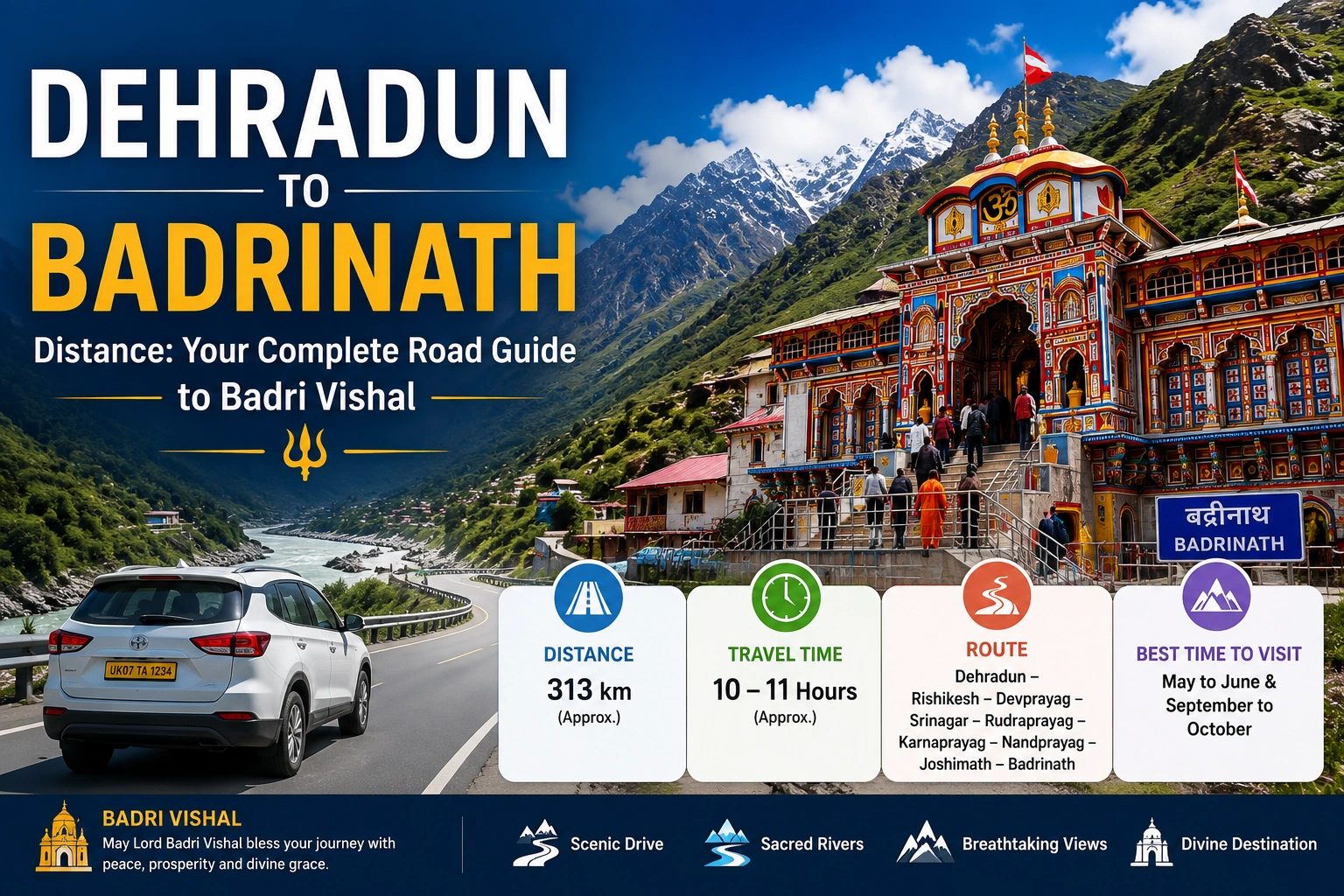
The Dehradun to Badrinath distance by road is approximately 320 to 340 km, depending on the exact route and how you measure it. Google Maps typically shows around 324 km from the centre of Dehradun to the Badrinath temple — but experienced travellers know this number is only part of the story.
The journey takes 10 to 12 hours under normal conditions. Some days it’s 9 hours. Some days, especially during peak char dham yatra season or after a night of rain in the hills, it can stretch to 14. The mountain roads don’t run on schedules.
The route goes like this:
Dehradun → Rishikesh → Devprayag → Srinagar (Garhwal) → Rudraprayag → Karnaprayag → Nandprayag → Chamoli → Joshimath → Vishnuprayag → Govindghat → Badrinath
Every one of those stops on this list is worth a pause. Most travellers treat this as a one-day drive. The wiser ones break it into two days, halting at Joshimath or Srinagar overnight — which is also kinder to your body at altitude.
What is Badrinath? A Brief Introduction Before You Go
Badrinath sits at an elevation of around 3,100 to 3,300 metres (approximately 10,200 to 10,800 feet) above sea level in the Chamoli district of Uttarakhand. The town rests on the banks of the Alaknanda River, flanked by the Nar and Narayan mountain ranges, with the iconic Neelkanth peak rising like a crown behind the temple.
It is one of the holiest towns in Hinduism — the northernmost point of the Char Dham Yatra, the first Indian village before the Tibet border is just 3 km away at Mana. In winter, Badrinath disappears under snow for six months. In summer, when the temple opens on Akshaya Tritiya, it comes alive with the prayers, the bells, and the smell of incense cutting through cold mountain air.
This is not a comfortable, polished hill station. It’s raw, high-altitude, and deeply sacred. Which is exactly why millions come.
Why Badrinath Holds a Place Unlike Any Other in Indian Pilgrimage
Most pilgrimage towns are sacred because of what happened there. Badrinath is sacred because of what is believed to still happen there.
According to Hindu tradition, Lord Vishnu came to this spot to meditate — and Goddess Lakshmi herself transformed into a Badri (berry) tree to shield him from the harsh Himalayan weather. The name Badrinath literally carries that story within it. The main deity here, Lord Badrinarayan, is worshipped in a meditative posture — not in triumph, not in battle, but seated still, in deep contemplation. The air around the temple feels like it carries that stillness with it.
Architecturally, the temple is striking — painted in bold shades of white, blue, and red, with a distinctive conical tower. Against the backdrop of perpetually snow-streaked peaks, it looks like something painted rather than built. The natural hot spring of Tapt Kund at the base of the temple, where pilgrims bathe before entering, steams at around 45°C even when the surrounding temperature is near freezing. That contrast — scalding water, freezing air — is one of the most memorable physical sensations of the entire yatra.
Religious Importance: Char Dham, Chota Char Dham, and Beyond
Badrinath holds an unusual distinction in Indian pilgrimage geography. It is part of both the pan-India Char Dham (Badrinath, Dwarka, Puri, Rameswaram) and the Uttarakhand Chota Char Dham (Badrinath, Kedarnath, Gangotri, Yamunotri). No other temple in India holds membership in both circuits.
The temple is also among the 108 Divyadeshams — Vishnu temples celebrated in the devotional hymns of the Alvars. Ancient texts including the Skanda Purana and the Mahabharata mention Badarikashram (Badrinath’s ancient name) specifically. The Pandavas are believed to have passed through here on their Swargarohana — their ascent toward heaven — and the route from Rishikesh to Badrinath via the Panch Prayag is said to follow that same ancient path.
For Vaishnavas especially, completing Badrinath Dham is a deeply personal milestone. For many families, it is a once-in-a-lifetime journey. For some pilgrims who return year after year, it has become a relationship — a conversation kept alive across decades.
Quick Reference: Badrinath at a Glance
|
Detail |
Information |
|
Altitude |
~3,100–3,300 m (approx. 10,200–10,800 ft) |
|
District |
Chamoli, Uttarakhand |
|
River |
Alaknanda |
|
Nearest Airport |
Jolly Grant Airport, Dehradun (~317 km) |
|
Nearest Railway Station |
Rishikesh (~295 km) |
|
Temple Opens |
Around Akshaya Tritiya (April/May) |
|
Temple Closes |
Around Diwali (October/November) |
|
Best Season |
May–June & September–October |
|
Distance from Dehradun |
~320–340 km by road |
|
Typical Drive Time |
10–12 hours |
|
Nearest Town with Services |
Joshimath (48 km before Badrinath) |
What You’ll Experience in Badrinath: Beyond the Temple Visit
The darshan at Badrinath temple is the centrepiece — but the hours around it are what most pilgrims carry home in memory.
Tapt Kund is the natural thermal spring just below the temple. The water smells faintly of sulphur, and it’s genuinely hot — people lower themselves in slowly, wincing, then go still as the warmth spreads through travel-tired muscles. Most pilgrims bathe here at dawn before morning aarti. In the cold air of the Himalayas, the rising steam from the kund looks almost otherworldly.
Mana Village, 3 km from the temple, is often called the last Indian village before Tibet. The lanes are narrow stone-paved corridors between traditional homes. The famous Bhim Pul — a natural stone bridge over the roaring Saraswati River — is here, along with the Vyas Gufa (the cave where sage Vyasa is believed to have composed the Mahabharata). The cold here bites harder than in Badrinath town; the wind carries it.
Brahma Kapal is a flat rock platform above the Alaknanda where Hindu families perform rituals for the peace of departed ancestors. It holds a quiet, heavy gravity — the kind that makes you speak softly.
Charanpaduka, a brief uphill walk from the temple, marks the stone imprinted with what tradition says are Vishnu’s footsteps. Standing there, looking down at the Badrinath valley below, the scale of the Himalayas around you becomes fully real.
Temples and Sacred Stops En Route: Dehradun to Badrinath
The road from Dehradun to Badrinath is as spiritually loaded as the destination itself. You pass through five of the holiest river confluences in Hinduism — the Panch Prayag — each one a temple town in its own right.
Rishikesh (from Dehradun: ~43 km)
The first major stop. Rishikesh sits at the foot of the Himalayas where the Ganga emerges from the hills and begins her journey to the plains. The ghats here — Triveni Ghat, Parmarth Niketan — are active from early morning. The Ganga Aarti at Parmarth each evening is one of the most visually arresting sights in all of Uttarakhand: priests in saffron robes, fire moving in slow circles, the river carrying the light downstream.
Devprayag (from Dehradun: ~113 km)
This is where the Alaknanda and Bhagirathi rivers merge to form the Ganga — the most sacred confluence in the Panch Prayag. The water colours are visibly different on each side before they blend. Devprayag has a small, ancient Raghunath Temple dedicated to Lord Vishnu that is worth visiting. The town perches between the two rivers, the air thick with the sound of rushing water from every direction.
Rudraprayag (from Dehradun: ~178 km)
The Mandakini and Alaknanda meet here — and this is also where the road divides: one fork heads to Kedarnath, the other continues toward Badrinath. The Koteshwar Temple, carved into a riverside cave, is a powerful detour — Lord Shiva is believed to have meditated here before heading to Kedarnath. The cave temple is cool and dim, lit by oil lamps, and the sound of the river pressing against the rock outside is constant.
Karnaprayag (from Dehradun: ~211 km)
The Pindar River meets the Alaknanda here. A quieter confluence, with an Uma Devi temple above the meeting point. Many travellers stop for chai and paratha at the roadside dhabas before continuing.
Nandprayag (from Dehradun: ~231 km)
Nandakini meets Alaknanda. A smaller, calmer prayag — easy to drive through without stopping, but worth a brief pause. The view from the bridge is one of the most photogenic on the entire route.
Joshimath (from Dehradun: ~282 km)
The last town of any significant size before Badrinath. At around 1,890 metres, Joshimath serves as the winter seat of Lord Badrinath — when the Badrinath temple closes in October/November, the deity’s idol is ceremonially brought here to Narasimha Temple for the winter. This is also the base for Auli (skiing in winter, meadows in summer) and the Valley of Flowers trek. Most pilgrims stop here for a meal and, ideally, a night’s rest to acclimatise before the final push to Badrinath at over 3,000 metres.
How to Reach Badrinath from Dehradun: Your Transport Options
By Private Taxi or Cab (Recommended)
This is the most comfortable option for families, seniors, and pilgrims who want control over stops and timing. A Dehradun to Badrinath taxi typically costs ₹4,000 to ₹7,500 for a one-way trip in a sedan (Swift Dzire or similar). For an SUV like Innova Crysta or Ertiga — better suited for mountain roads — Dehradun to Badrinath cab fares range from ₹7,000 to ₹12,000 one-way, depending on the operator and season.
For a round-trip package (2–3 days with overnight stay included), combined packages typically start around ₹10,000 to ₹15,000, and full Char Dham tour packages from Kedarnath Tourism include all logistics, stays, and support.
Always book your cab with a reputable operator who uses hill-experienced drivers — the road past Joshimath is narrow, steep, and not forgiving of inexperience.
By Bus
There are no direct buses from Dehradun to Badrinath. You’ll need to first reach Rishikesh or Haridwar by local bus or taxi (~45–50 km), then board a Badrinath-bound bus. GMVN buses and private operators run seasonal services. One-way bus fare from Rishikesh to Badrinath typically runs ₹800 to ₹1,400. Buses are economical but offer limited flexibility for stops and can get crowded during peak yatra season.
By Helicopter
Helipad services operate from Sahastradhara in Dehradun to Badrinath during the yatra season. This is the fastest option (roughly 30–40 minutes in the air), but seats are limited, pricing is premium, and weather cancellations are common. Best for elderly pilgrims or those with health restrictions.
By Train + Road
Rishikesh is the nearest railhead (~295 km from Badrinath). From Dehradun, take a train to Rishikesh (about 1.5–2 hours), then hire a taxi onward. Haridwar (another major railhead) is slightly further but better connected by rail from most major cities.
Where to Stay in Badrinath: Honest Overview
Accommodation in Badrinath is functional rather than luxurious. This is a high-altitude pilgrimage town that shuts down every winter — don’t arrive expecting polished hotel lobbies.
GMVN Tourist Bungalow is the most reliable government option — clean, basic rooms, reasonable tariffs. Book in advance during peak season (May–June) as they fill up fast.
Dharamshalas and Ashrams run by religious trusts offer the most affordable stays — often ₹200–₹500 per night for a basic room. The Badrinath-Kedarnath Temple Committee (BKTC) operates several dharamshalas here. Meals are simple and vegetarian.
Private Guesthouses have grown in number over the years — expect rooms with attached bathrooms, hot water (usually from a geyser, not always reliable at this altitude), and basic bedding. Prices range from ₹800 to ₹3,000 per night depending on season and location.
For a more comfortable base with better amenities, Joshimath (48 km away) offers better hotel options and is the recommended overnight stop before Badrinath. It’s also significantly warmer than Badrinath at night.
Food in and Around the Route
Badrinath town has a handful of small restaurants and dhabas serving simple vegetarian food — dal, rice, puri bhaji, aloo sabzi. The cold air makes hot food taste better than it normally would. A cup of ginger tea with your hands wrapped around it, looking out at the Neelkanth peak — that’s one of those small, perfect moments.
Alcohol and non-vegetarian food are not available in Badrinath town. This is a strictly vegetarian zone by custom and religious sentiment.
Along the route, Joshimath offers the widest variety of options — proper sit-down restaurants with dal makhni, roti, and seasonal local vegetables. Rudraprayag and Karnaprayag are good spots for mid-journey meals at clean dhabas. For breakfast, Rishikesh has excellent options — the cafes near Laxman Jhula serve everything from aloo paratha to banana pancakes.
If you’re travelling by private cab, ask your driver about their preferred dhaba stops — local drivers know which ones are hygienic, quick, and reliable.
Best Time to Visit Badrinath
May to June (Peak Season — Ideal)
The yatra season opens, typically around Akshaya Tritiya in late April or early May. The weather is cold but clear — daytime temperatures around 10–15°C, nights can drop to 2–5°C. The skies are usually sharp and blue, the peaks vivid against them. Roads are at their best and most accessible. This is the busiest period — expect crowds at the temple, queues for darshan, and higher accommodation rates. Book everything in advance.
July to August (Monsoon — Caution Advised)
Rain turns the mountain roads unpredictable. Landslides are a real hazard on certain stretches, especially between Joshimath and Badrinath. Travel is possible but check BKTC travel advisories before heading out. Some pilgrims choose this window intentionally for the dramatic waterfalls and lush green hillsides, but the risks are real and should not be underestimated.
September to October (Post-Monsoon — The Best-Kept Window)
Crowds thin out, skies clear, and the mountains show themselves more generously. This is arguably the most beautiful time to visit Badrinath — the air has the crispness that high altitude takes on in early autumn, the temple is still open, and you can often walk to the main sanctum with minimal wait. Temperatures start dropping sharply in October. The temple closes around Diwali — usually in late October or early November.
November to April (Closed Season)
The temple is shut, roads are buried in snow, and Badrinath is accessible only in exceptional circumstances. Not a travel window for regular pilgrims.
Also Read: Best Time to Visit in Uttarakhand
Char Dham Tour Packages by Kedarnath Tourism
If Badrinath is part of your wider pilgrimage plan — and for many travellers, it is — Kedarnath Tourism offers comprehensive Char Dham Yatra packages designed around the real logistics of Himalayan travel.
Our Char Dham packages cover Yamunotri, Gangotri, Kedarnath, and Badrinath in a structured itinerary that takes the guesswork out of bookings, routes, and overnight stays. We work with experienced mountain drivers, carefully selected accommodation across the yatra circuit, and flexible itineraries that give you time at each dham — not just a rushed darshan and a drive away.
Whether you’re travelling solo, as a family, or as a senior pilgrim who needs extra comfort support, we build itineraries around your pace. We also offer standalone Badrinath packages from Dehradun or Rishikesh for those who want to complete this one dham at a time.
Practical Travel Tips for Badrinath
Start early, every day. Leave Dehradun by 4:00–5:00 AM at the latest. Mountain roads slow down in the afternoon — between tourist buses, local transport, and occasional road work or weather delays, early starts are the difference between a relaxed journey and a stressful one.
Acclimatise at Joshimath. If you’re coming from a city in the plains, spending a night at Joshimath (1,890 m) before going to Badrinath (3,100+ m) significantly reduces the risk of altitude sickness. Symptoms — headache, nausea, dizziness — can sneak up on you if you ascend too quickly.
Pack layers, not just warmth. The temperature at Badrinath can swing 15°C between noon and midnight. Thermal innerwear, a fleece, and a waterproof wind-stopper jacket cover most situations. Even in May, carry gloves and a cap for the mornings.
Carry cash. ATMs exist in Joshimath, but they run out of cash during peak season and can be unreliable beyond that point. Carry sufficient cash for accommodation, meals, and offerings from Joshimath onward.
Register for yatra online. The Uttarakhand government requires biometric/tourist registration for Char Dham Yatra pilgrims. Complete this on the official Devasthanam Board portal before travel — carrying a printed confirmation saves time at checkpoints.
Respect the no-photography rule. Photography inside the Badrinath temple sanctum is strictly prohibited. Keep phones away when entering the inner shrine.
Check road conditions before departure. The Uttarakhand Tourism and SDRF (State Disaster Response Force) websites and local news channels provide real-time road condition updates. In the monsoon season especially, don’t skip this step.
The Road Will Change You — If You Let It
The Dehradun to Badrinath distance on paper is 320-odd kilometres. In experience, it’s something else entirely. It’s the Ganga appearing grey-green through eucalyptus trees as you pass Rishikesh. It’s the shock of two rivers — different colours — joining at Devprayag. It’s the moment Joshimath appears around a bend and you realise you’ve left the world you know behind. And it’s standing at Tapt Kund at six in the morning, the cold air on your face, the hot spring water below your feet, the temple bells starting somewhere above — and understanding, even briefly, what people have been coming here for centuries to find.

