
 Blog
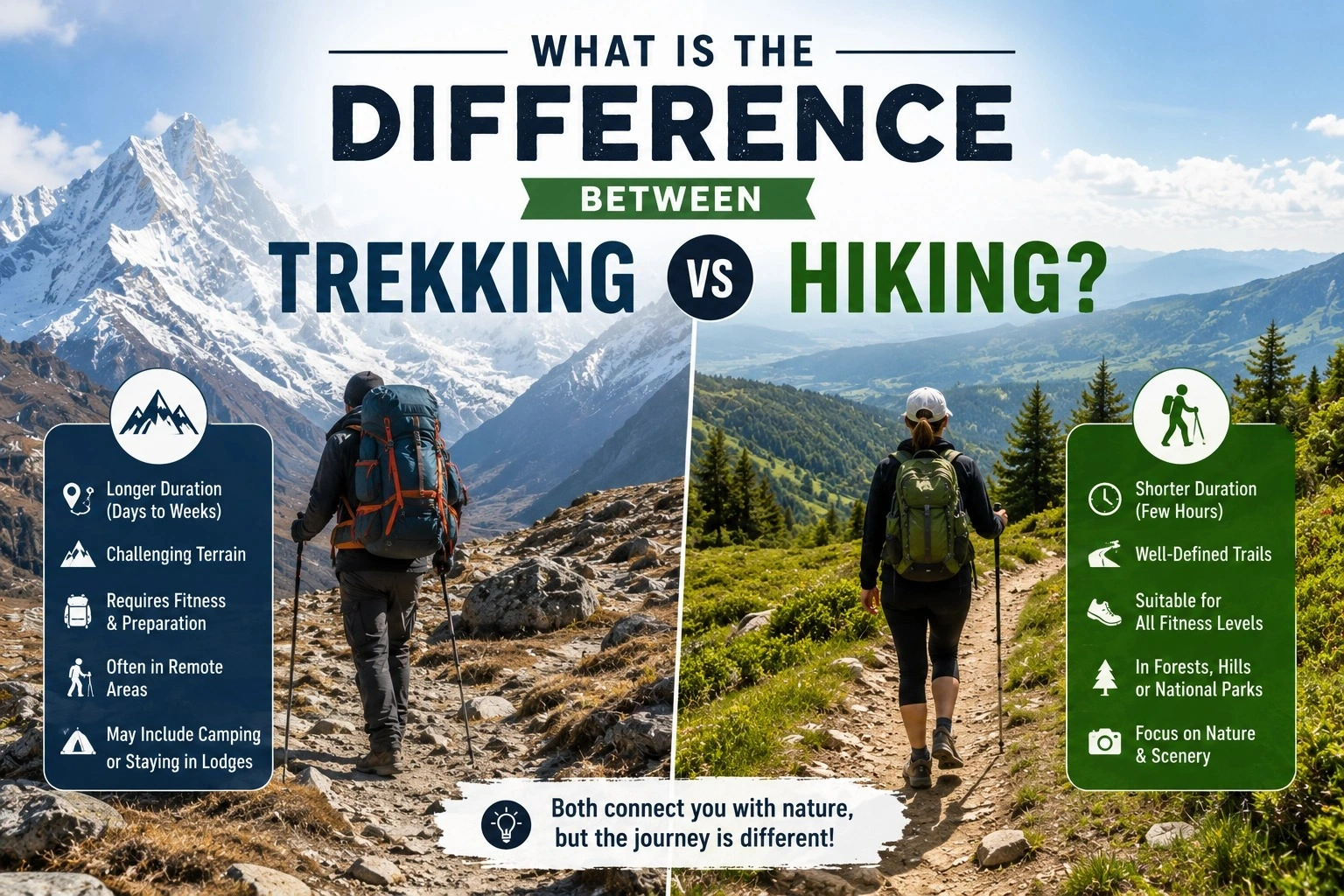
BlogThe main difference between trekking and hiking is the duration and the difficulty of the path you follow. Hiking is generally a one-day walk on marked trails, while trekking is a multi-day journey through remote, often unmarked terrain where you carry your own supplies.
At Kedarnath Tourism, we’ve been guiding people through the Garhwal Himalayas since 2012. We’ve seen that many people use these terms interchangeably, but knowing the distinction helps you pack the right gear and prepare your body for the specific demands of the Uttarakhand mountains.
What is a Hike?
In our local context around Ukhimath, a hike is a purposeful walk on beautiful, well-maintained paths. You aren’t worried about where you will sleep because you’ll be back at your hotel or guest house by sunset.
When people ask us what is hiking and trekking, we explain that hiking is about “recharging.” It’s a way to see the Deodar forests or a high-altitude meadow without the stress of a heavy pack. A hike usually lasts anywhere from 2 to 8 hours.
For example, the walk from Chopta to Tungnath is a classic hike. It is about 3.5 kilometers one way. The path is paved with stones, there are tea stalls along the way, and you can easily return to Chopta for lunch. This is a perfect example of what a hike feels like in the Himalayas.
Why do people prefer hiking?
Hiking is accessible. You don’t need to be an athlete to enjoy a hike in the lower Garhwal region. It allows you to experience the crisp mountain air and see the peaks like Chaukhamba or Kedarnath Dome without a massive time commitment. It’s also much easier on the knees than a long-distance trek.
What is a trek?
A trek is a completely different beast. If you are wondering what is the meaning of trekking and hiking, think of trekking as a “pilgrimage of endurance.” It is a long, multi-day journey through areas where there are no roads. You are often crossing passes, walking through deep valleys, and sleeping in tents or basic homestays.
Trekking requires a “moving camp” mentality. You carry your clothes, sleeping bag, and sometimes your food. In our region, the Kedarnath Yatra trek is the most famous. It’s a 16km steep climb from Gaurikund. While many do it in a day, the physical toll and the altitude make it feel much more like a trek than a simple hike.
Other examples include the Panch Kedar circuit. To reach Madmaheshwar or Rudranath, you are looking at several days of walking 10 to 15 kilometers daily. There is no “going back to the hotel” until the journey is complete. This is the core of what is a trek.
The spirit of the trek
In Uttarakhand, trekking is often tied to spirituality. Whether you are heading to a remote shrine or a hidden glacial lake like Vasuki Tal, the trek is part of the penance. It tests your mental resolve just as much as your physical strength.
What is the difference between trekking and hiking in terms of terrain?
The terrain is the biggest giveaway. If you are on a “Pugdundee” (a narrow local trail) that disappears into a rock fall or requires you to cross a cold stream on logs, you are trekking.
Hiking Terrain:
- Pre-defined and marked trails.
- Often located within forest reserves or near hill stations.
- The incline is usually manageable for a person with average fitness.
- Paths are often cleared of large debris.
Trekking Terrain:
- Diverse and unpredictable. You might walk on lush grass in the morning and over hard ice or loose scree by the afternoon.
- Significant altitude gain. You might start at 1,500m and end the day at 3,500m.
- Cross-country elements where the trail is just a suggestion.
- Steep “Khada Chadhai” (vertical climbs) that require frequent breaks.
Is hiking and trekking the same when it comes to gear?
No, and wearing the wrong shoes is the fastest way to ruin your trip. We’ve seen many yatris try to do the [Char Dham] routes in simple sneakers. While you might survive a short hike in them, a trek will destroy your feet and the shoes.
Essential Hiking Gear:
- Lightweight Daypack: 15–25 liters to carry water, a rain jacket, and snacks.
- Trail Shoes: Breathable shoes with a good grip (Vibram soles are a plus).
- Water Bottle: At least 1 liter.
- Sun Protection: A hat and high-SPF sunscreen. The mountain sun at 3,000m is very sharp.
Essential Trekking Gear:
- Large Rucksack: 50–70 liters if you are carrying your own gear.
- Ankle-Support Boots: Essential for protecting against sprains on uneven rocks.
- Layered Clothing: The “Three-Layer Rule”—a moisture-wicking base, a warm fleece middle, and a waterproof outer shell.
- Trekking Poles: These save your knees by 25% on the steep descents back to Ukhimath or Gaurikund.
- First Aid & Meds: Including Diamox for altitude (after consulting a doctor) and basic bandages for blisters.
How to Physically Prepare for a Hike?
Since a hike is shorter, your preparation can be less intense, but you shouldn’t ignore it. If you are coming from the plains (like Delhi or Mumbai), the thin air will surprise you.
- Focus on Cardio:
Spend 30 minutes 3 times a week on a treadmill or jogging. You want your heart to be used to sustained effort.
- Leg Strength:
Do basic squats and lunges. This helps when you are walking uphill toward places like Deoria Tal.
- Test Your Gear:
Never wear brand-new shoes on a hike. Wear them around your house or local park for at least a week to make sure they don’t pinch.
How to Physically Prepare for a Trek?
Preparing for a trek like the [Panch Kedar] or a high-altitude expedition requires at least 2–3 months of dedicated effort. You are training for “load-bearing endurance.”
- Weighted Walks:
Put on the backpack you plan to use, fill it with 5kg of books, and go for a walk. Gradually increase the weight to 10kg. This conditions your shoulders and lower back.
- Breathing Exercises:
In the Himalayas, we swear by Pranayama. Deep breathing exercises help your lungs become more efficient at absorbing oxygen, which is vital once you cross the 3,000m mark.
- Stair Climbing:
This is the best simulation for Himalayan trekking. Find a building with 5–10 floors and climb the stairs daily. Your quads and calves need to be “mountain ready.”
- Mental Conditioning:
Trekking can be uncomfortable. It might rain, your tent might be cold, or you might be tired. Practice staying calm during physical exertion. This is why hiking and trekking are the best teachers of patience.
Is trekking and hiking the same for families?
If you are traveling with children or elderly parents, we usually recommend hiking over trekking. A 4-hour hike allows for plenty of “Maggi breaks” and photo sessions without the risk of exhaustion or altitude sickness.
Best Family Hikes near Ukhimath:
- Deoria Tal: A 2.5km walk from Sari village. The lake reflects the Chaukhamba peaks and is safe for kids.
- Ukhimath Local Trails: Exploring the ancient stone paths around the Omkareshwar Temple.
Can families trek?
Yes, but it requires a pony or a “Palki” for those who cannot walk long distances. If you want to do a family trek, the route to Kedarnath is the most supported with medical facilities and resting points. However, always check the weather. A trek becomes much harder for a family if the weather turns sour.
Must read books on trekking and hiking
To truly understand the spirit of the mountains before you arrive, we suggest reading these classics. They capture the meaning of trekking and hiking better than any brochure:
- The Man-Eaters of Kumaon by Jim Corbett: While about hunting, it gives an incredible look at the Garhwal and Kumaon terrain we walk through.
- Land of the Seven Rivers by Sanjeev Sanyal: Great for understanding the geography and history of the paths you’ll tread.
- Himalayan Journals by J.D. Hooker: A deeper look into the flora and fauna of the high altitudes.
- Ancient Bihar to High Himalayas: Any local guidebook that details the spiritual significance of the Char Dham routes.
Reading these will help you see that a trail is not just a path, but a story that has been walked for thousands of years.
Why hiking and trekking are the best ways to see Uttarakhand
You can see the mountains from a car window, but you won’t feel them. When you are on foot, you smell the pine needles, you hear the distant bells of the sheep, and you drink water straight from a glacial “Dhara” (stream).
What’s the difference between hiking and trekking when it comes to the experience?
Hiking gives you a beautiful “snapshot” of the mountains. Trekking gives you the whole “movie.” In a trek, you see the landscape change from thick oak forests to alpine meadows (Bugyals) and finally to the stark, beautiful rocks of the high peaks.
At Kedarnath Tourism, we believe that walking these paths makes you a different person. You return home with a quieter mind and stronger legs. Whether you choose a simple hike to Tungnath or a challenging trek to the shrine of Lord Shiva, the mountains will welcome you.
Summary of Differences
Feature | Hiking | Trekking |
Duration | Few hours to one day | Multiple days/weeks |
Accommodation | Return to hotel/home | Tents, homestays, or camps |
Difficulty | Easy to Moderate | Moderate to Difficult |
Gear | Light pack, trail shoes | Heavy rucksack, sturdy boots |
Path | Marked and maintained | Often rugged and remote |
Physical Need | Basic fitness | High endurance & strength |
Frequently Asked Questions
What is the difference between trekking and hiking?
Hiking is a short, usually one-day walk on marked trails. Trekking is a long, multi-day journey in wilder, more remote areas.
Is hiking harder than trekking?
Generally, no. Trekking is harder because it involves more days, higher altitudes, and carrying more weight. However, a very steep hike can be more intense than a flat trek.
Can I go trekking without prior experience?
Yes, but you should start with “Easy” or “Moderate” rated treks. It is always better to go with a local guide who knows the weather and the shortcuts.
What should I carry for a day hike in Uttarakhand?
Carry 2 liters of water, a lightweight raincoat, high-energy snacks (like nuts or chocolate), a basic whistle, and a power bank for your phone.
Why is trekking often associated with pilgrimage in India?
Many of our most sacred sites, like Kedarnath or Hemkund Sahib, were built in remote high-altitude areas precisely because the journey (the trek) was meant to be a test of faith and devotion.


