
 Blog
BlogGaurikund — Gateway to Kedarnath You Need to Know Before You Go
Altitude 1,982 m · Last motorable point · 19 km trek to Kedarnath shrine · Gaurikund Temple · Hot springs
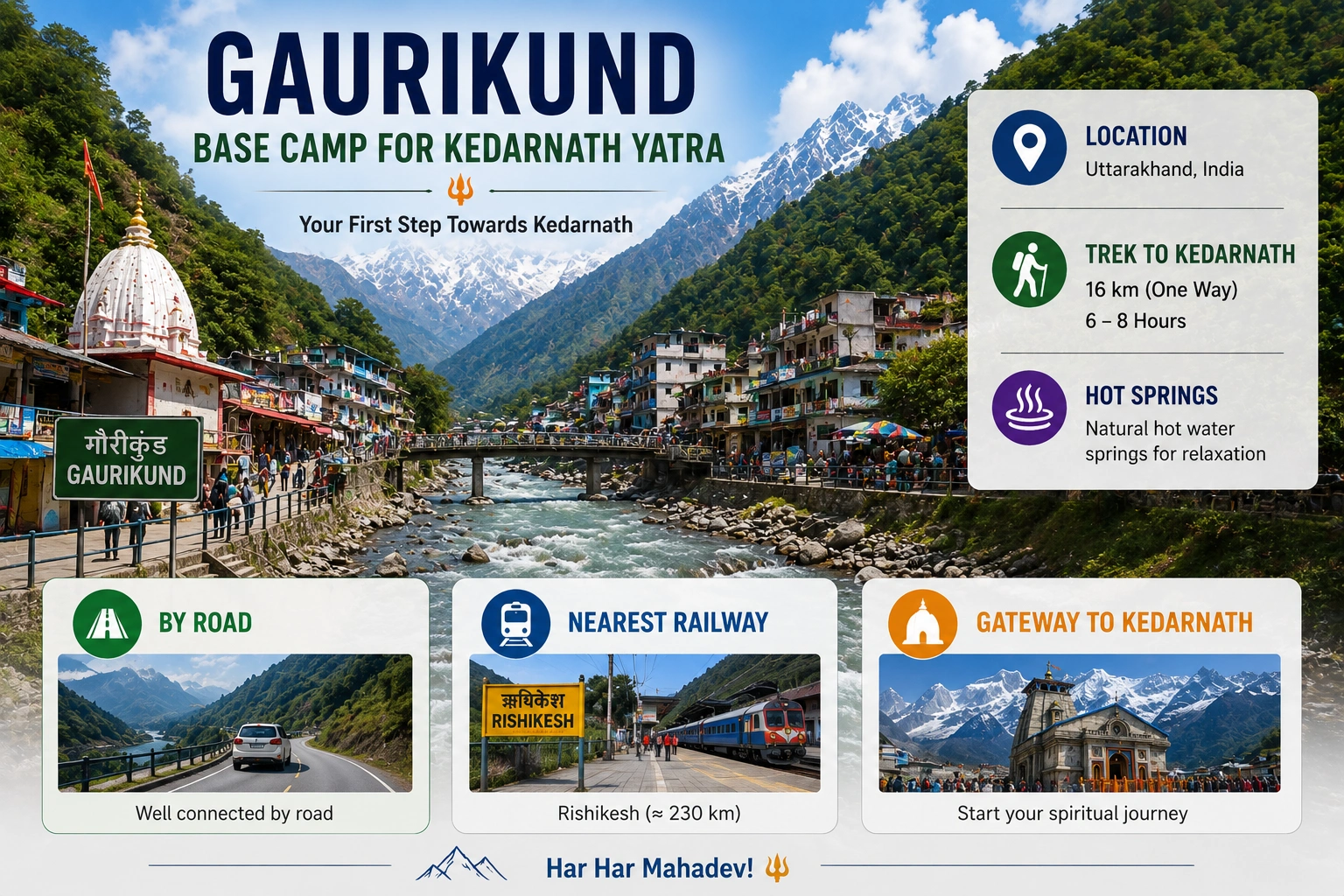
Gaurikund is where the road ends and the Kedarnath Yatra truly begins. Sitting at 1,982 metres in Rudraprayag district, this small pilgrim town is the last point your taxi, bus, or car can take you. From here, the 19-kilometre trek to the Kedarnath shrine starts — and for most yatris, Gaurikund is their first real taste of the mountains.
We've been guiding pilgrims from Kedarnath Tourism since 2012, and in all that time, one thing stays constant: people arrive at Gaurikund underprepared. Not spiritually — physically. They don't know where to register, where the horses start, how cold it gets at night, or what the Gaurikund Temple timings are. This guide fixes that.
Whether you're planning a Kedarnath Yatra for the first time or returning after years, this page covers every practical detail — distances from major cities, the Gaurikund Temple, the hot spring, what the weather is like season by season, and what it costs to trek or take a horse from Gaurikund to Kedarnath. Read once, plan well.
📌 Quick Facts
What Is Gaurikund and Why Does Every Kedarnath Pilgrim Pass Through It?
Gaurikund is a small temple town and pilgrim settlement in the Mandakini river valley, about 5 km from Sonprayag. The name comes from Goddess Gauri — another name for Parvati — and local tradition says she meditated here for years to win Lord Shiva's heart. The kund, a natural hot water spring, is said to be where she bathed before their divine union.
From a practical standpoint, Gaurikund matters because it's the official trek starting point for Kedarnath. Private vehicles are not allowed beyond Sonprayag, so pilgrims take shared jeeps (5 km, roughly ₹30–50 per seat) from Sonprayag to Gaurikund. From there, the only way forward is by foot, horse, palki, or helicopter (helicopters depart from Guptkashi / Phata / Sirsi, not Gaurikund).
It's also a registration checkpoint. The Biometric Registration counter at Gaurikund is mandatory for all pilgrims proceeding to Kedarnath. If you didn't register online before leaving home, you register here. Don't skip this step — SDRF personnel check your registration slip at multiple points on the trail.
Gaurikund Temple — Goddess Parvati's Meditation Seat
The Gaurikund Temple is dedicated to Goddess Gauri (Parvati) and sits right at the edge of the pilgrim settlement. It's a compact temple, not a grand structure — carved stone, a low shikhara, and a constant scent of incense mixing with mountain air. Inside, the main deity is Goddess Gauri in her beautiful, graceful form.
Most pilgrims do a quick darshan at Gaurikund Temple before starting the trek. It's considered auspicious to seek Mata Gauri's blessings before going to seek Lord Shiva at Kedarnath. The belief is that Parvati prepares the way — that you go to her first before him. We've heard this from local pandas and it makes deep devotional sense.
🕐 Temple Timings
- Morning Aarti: 5:00 AM – 6:00 AM
- Darshan Open: 6:00 AM – 12:00 PM
- Afternoon Break: 12:00 PM – 3:00 PM
- Evening Darshan: 3:00 PM – 8:00 PM
- Evening Aarti: 7:00 PM – 8:00 PM
- Closed: During Kedarnath off-season (Nov–Apr)
🌊 Hot Spring Kund
- Natural sulphur hot spring
- Separate bathing areas for men and women
- Open from approx 5:30 AM to 8:00 PM
- No entry fee (donations accepted)
- Water temperature: ~45–55°C
- Best visited early morning before crowds
The hot spring kund is genuinely worth stopping at, not just for ritual. After a cold night in Gaurikund, sliding into that warm sulphur water before you start the 19 km trek is one of those small gifts the mountains give you. Go early — by 7 AM the queues are already long during peak season.
There's also a Shiv temple and a small Hanuman shrine adjacent to the main Gaurikund temple complex. The entire darshan, including hot spring bath, shouldn't take more than 1.5 to 2 hours if you're organised.
Planning Your Kedarnath Yatra from Gaurikund?
We've been arranging Kedarnath packages from Haridwar, Rishikesh, and Dehradun since 2012. Taxi, guide, accommodation — sorted in one call.
Gaurikund to Kedarnath Distance, Trek Route, and How Long It Takes
The Gaurikund to Kedarnath distance is 19 kilometres by the official trekking route. This is the primary route used by pilgrims, horses, and palanquins. The trek ascends from 1,982 metres at Gaurikund to 3,584 metres at the Kedarnath temple — a gain of roughly 1,600 metres over 19 km.
On foot, a reasonably fit adult who isn't used to high altitude takes 7 to 9 hours for this trek. Experienced trekkers do it in 5 to 6 hours. People who are very new to trekking or who have altitude sensitivity should plan for a full day with rest breaks. Do not rush this trek — altitude sickness can affect anyone, and the trail gets narrow and slippery in sections beyond Linchauli.
Key Waypoints on the Gaurikund to Kedarnath Trek
Gaurikund
Registration check, horse booking, hot spring bath. Shops sell trekking sticks (₹50–100 rental), glucose biscuits, and warm layers. Fill water here.
Jungle Chatti
First proper rest point with tea stalls. The initial 2 km out of Gaurikund is steep — this is where most people realise they should have rented that trekking stick.
Bheembali
GMVN rest facility, food stalls, toilet blocks. A solid mid-point for families. Horses can be hired here too if you didn't get one at Gaurikund.
Linchauli / Rambara Area
The old Rambara bridge was destroyed in the 2013 disaster. The new trail bypasses this area. There are temporary stalls and water points. Pace yourself — you're now past halfway.
Garud Chatti
Last major tea-and-rest stop. From here, the trail steepens noticeably. Many pilgrims who started confidently start slowing down here. Eat something small, drink water.
Kedarnath Valley Viewpoint
You'll see Kedarnath for the first time from here — the white temple against the dark Kedarnath peak. Most pilgrims stop here and weep or shout "Jai Bhole." It's earned.
Kedarnath Temple
The ancient Jyotirlinga shrine. Check into your tent or dharamshala accommodation, then queue for evening darshan. Come back for the morning aarti at 4 AM.
Horse one-way: ₹2,500–₹3,500 (fixed by govt) · Palki (4 bearers): ₹7,500–₹10,000 one-way · Pittu (back carrier): ₹2,000–₹2,500 · Rates change slightly each season — confirm on arrival. Book early during peak months (May–June).
How Far Is Gaurikund from Major Cities? (Road Distance Guide)
Below are accurate road distances to Gaurikund from cities pilgrims typically start from. All distances are via the main NH58/NH7 route through Devprayag, Srinagar (Garhwal), and Rudraprayag. Note that vehicles can only go to Sonprayag — the last 5 km to Gaurikund is by shared jeep (₹30–50/seat) or on foot.
| From | Distance to Gaurikund | Travel Time (approx) | Route Tip |
|---|---|---|---|
| Rishikesh | ~222 km | 7–9 hrs | Via Devprayag–Srinagar–Rudraprayag–Sonprayag |
| Haridwar | ~247 km | 8–10 hrs | Rishikesh first, then NH7 into the mountains |
| Dehradun | ~269 km | 8–10 hrs | Via Rishikesh or Mussoorie–Chamba–Tehri (longer but scenic) |
| Sonprayag | ~5 km | 20–30 min | Shared jeep from Sonprayag parking area |
| Rudraprayag | ~76 km | 2.5–3 hrs | Via Agastmuni–Tilwara–Ukhimath road or NH7 |
| Guptkashi | ~33 km | ~1.5 hrs | Via Phata–Sitapur–Sonprayag |
| Badrinath Temple | ~239 km | 8–10 hrs | Via Rudraprayag–Chamoli–Joshimath (not direct, go via Rishikesh) |
| Delhi | ~490 km | 14–16 hrs | Via Haridwar/Rishikesh; overnight journey recommended |
Sonprayag to Gaurikund — Why This 5 km Matters
Sonprayag is where the Kedarnath administration's vehicle control begins. All private vehicles (including taxis and self-drive) must park at Sonprayag — they cannot proceed to Gaurikund. The district authorities have strict rules about this, and it applies even to official government taxis during peak season.
From Sonprayag, shared jeeps ferry pilgrims to Gaurikund continuously from early morning to around 8 PM. The queue moves fast, and the 5 km road climbs steadily along the Mandakini river gorge. Sonprayag to Gaurikund distance is 5 km, takes 20–30 minutes by jeep. Walking is also possible but the road is narrow with vehicle traffic — not recommended for families with small children.
Gaurikund to Badrinath Distance — If You're Doing Char Dham
If you're on a Char Dham Yatra, you'll visit both Kedarnath and Badrinath. The road distance from Gaurikund to Badrinath Temple is approximately 239 km. Most pilgrims route this as: Gaurikund → Sonprayag → Rudraprayag → Chamoli → Joshimath → Badrinath. This takes 8–10 hours of driving time without stops.
There is no direct shortcut between Kedarnath and Badrinath. Some experienced trekkers do the Kedarnath–Vasuki Tal–Badrinath high-altitude traverse, but this is a multi-day mountaineering route, not a pilgrim trail. For the standard Char Dham, plan Kedarnath first, descend to Sonprayag, then drive toward Badrinath.
Need a Taxi from Haridwar, Rishikesh or Dehradun to Gaurikund?
We run private and shared cab services on all Kedarnath routes. AC sedans, Innova, Tempo Traveller — book 24 hrs in advance.
Gaurikund Temperature and Weather — What to Expect Month by Month
Gaurikund sits at 1,982 m so it runs cooler than the plains year-round. The weather here also changes fast — a clear morning can become overcast and cold by noon, especially during monsoon. Gauge your clothing requirements by night temperatures, not day temperatures.
May – June
July – Aug
Sept – Oct
Nov – Apr
What to pack for Gaurikund: Even in May, nights at Gaurikund drop to 8–10°C. Pack a fleece or light down jacket regardless of your travel month. Waterproof shoes or sandals with grip are a must — the trail past Gaurikund has streams and mud sections. Avoid cotton socks; they stay wet. Wool or synthetic blends only.
During monsoon (July–mid September), the Gaurikund weather can turn from sunny to heavy rain within an hour. The SDRF (State Disaster Response Force) posts updated trail conditions daily at the Gaurikund notice board. Check it every morning before starting. We've seen yatris turn back from Bheembali because they didn't check and got caught in flash floods higher up.
Gaurikund Uttarakhand — When Does the Yatra Season Open?
The Kedarnath Yatra opens on the auspicious day of Akshaya Tritiya (usually late April or early May) and closes on Bhai Dooj (usually late October or early November). The exact dates are announced by the temple committee every year. In 2025, the Kedarnath opening date was in early May.
Outside of these dates, Gaurikund village itself remains accessible but the Kedarnath trail above Garud Chatti is typically snow-covered and unsafe. The Gaurikund Temple remains open for local devotees year-round, but the hot spring kund is less maintained in the off-season.
How to Reach Gaurikund — By Road, Rail, and Air
There's no train or airport anywhere near Gaurikund — this is deep mountain terrain. Getting here requires a road journey of at least a few hours from the nearest railhead or airport. Here's the breakdown:
By Air
Nearest airport: Jolly Grant Airport, Dehradun (~269 km from Gaurikund). Cab from airport to Sonprayag takes 8–9 hours. No direct flight connects to the Kedarnath region.
By Train
Nearest railheads: Haridwar (~247 km) and Rishikesh (~222 km). Rishikesh railway station is small — most pilgrims arrive at Haridwar Junction (major station) and drive from there.
By Bus (UPSRTC / GMOU)
Government buses run Haridwar–Sonprayag routes daily during Yatra season. Journey time 9–11 hours. Book via UKMOTC or at Haridwar bus stand. Not available to Gaurikund directly.
By Private Taxi
Most comfortable option. Private cabs go to Sonprayag (not Gaurikund). Innova one-way from Haridwar: ₹5,000–₹7,000. We arrange pickup from any city — see our taxi service.
Haridwar to Gaurikund Distance and Road Route
The Haridwar to Gaurikund distance is approximately 247 km. The standard route follows NH58/NH7: Haridwar → Rishikesh → Devprayag → Srinagar (Garhwal) → Rudraprayag → Tilwara → Agastmuni → Kund → Guptkashi → Sitapur → Sonprayag → Gaurikund (by shared jeep).
This route takes 8 to 10 hours in normal traffic. During peak Yatra months (May–June), the stretch from Rudraprayag to Sonprayag can have vehicle queues — add 1–2 extra hours. Leave Haridwar by 5 AM to reach Sonprayag by early afternoon and still have light for Gaurikund check-in.
Rishikesh to Gaurikund Distance and Road Route
The Rishikesh to Gaurikund distance is approximately 222 km. Rishikesh is 25 km from Haridwar, so the route is the same after that point: Rishikesh → Devprayag → Srinagar → Rudraprayag → Sonprayag → Gaurikund. Travel time is 7–9 hours by private taxi, slightly more by state bus.
Many pilgrims fly into Delhi and take an overnight train or Volvo bus to Haridwar or Rishikesh, arriving by early morning. They then take a pre-booked taxi directly to Sonprayag without stopping. If this is your plan, let us know — we coordinate airport and station pickups with the mountain leg as a single arrangement.
Dehradun to Gaurikund Distance
The Dehradun to Gaurikund distance is approximately 269 km via Rishikesh. The alternate Mussoorie–Chamba–Tehri route is more scenic (especially around Tehri Dam) but takes roughly the same time or longer due to steeper mountain roads. Most cabs from Dehradun for Kedarnath Yatra take the Rishikesh route.
Registration, Rules, and Practical Things No One Tells You at Gaurikund
After 12+ years guiding pilgrims, we've noticed that most yatra regrets come from things people didn't know before arriving at Gaurikund — not from the trek itself. So here's the unglamorous but genuinely useful stuff:
- Biometric registration is mandatory. If you registered online at the Char Dham portal (registrationandtouristcare.uk.gov.in), carry a printout or screenshot. If not, register at the Gaurikund counter — bring your Aadhaar card. Unregistered pilgrims are turned back at checkpoints.
- Medical screening happens at Gaurikund. AYUSH doctors or health workers will check your pulse and blood pressure. If they flag you as unfit, they can refuse entry to the trail. People with heart conditions should get a clearance letter from their doctor at home.
- Time restriction on the trail. You must start trekking from Gaurikund before 12 PM (noon). Anyone attempting to start after noon is turned back by authorities — this rule prevents people from trekking in the dark. Plan accordingly.
- No plastic bags allowed on the Kedarnath trail. Carry a cloth bag or backpack. This is strictly enforced and you may be fined.
- Horse/palki booking has a set price list. Don't pay more than the government-fixed rates. The list is posted at the booking counters and at Gaurikund checkpost. Touts offering "priority" booking at double the price are not official.
- Helicopter doesn't leave from Gaurikund. Helipad is at Phata (near Guptkashi), Sirsi, and Kedarnath. If you've booked a helicopter, go to your departure point — not Gaurikund. Many first-timers make this mistake.
- Accommodation fills up fast in peak season. Book guesthouses in Gaurikund or Sonprayag at least 3–4 weeks in advance for May and June travel. GMVN guesthouses can be booked at gmvnl.com.
- Leave valuables in Sonprayag or Haridwar. Gaurikund accommodation is basic — no lockers. Take only what you need for the trek and the shrine visit. Keep your ID and cash in a money belt.
Where to Stay in Gaurikund — Accommodation Options
Gaurikund is not a hotel destination — it's a pilgrim overnight halt. Expect basic accommodation: clean rooms, hot water (sometimes), shared toilets in budget options, and blankets that have seen thousands of pilgrims. Luxury this is not. But warmth, good food, and genuine hospitality — yes.
Types of Accommodation Available
GMVN Tourist Rest House: Operated by Garhwal Mandal Vikas Nigam, this is the most reliable option. Rooms are basic but clean, blankets are provided, and there's usually hot water in the morning. Rates: ₹600–₹1,500 per room. Book at gmvnl.com or call their office in advance during peak season.
Private Dharamshalas and Guesthouses: There are 20–30 private guesthouses in Gaurikund. During peak May–June, rooms go for ₹800–₹2,000 per night depending on size and facilities. Ask about hot water availability before booking — some have electric geysers, others don't. Many also offer meals (₹100–₹200 per plate, simple dal-sabzi-rice).
Tent Camps: A few operators run tent camps on the outskirts of Gaurikund. These are suitable for trekkers but are very cold at night (especially in October). Good sleeping bags are essential.
Food at Gaurikund
Gaurikund has dozens of small dhabas serving pilgrim fare: aloo paratha, puri-sabzi, dal-rice, khichdi, chai, and Maggi. Nothing fancy — but after 7 hours of mountain driving, that chai in a clay cup hits exactly right. There's a GMVN canteen that's reliable for clean food. Fresh fruit (apples, bananas) is usually available from roadside carts — buy some for the trek.
Note on water: Packaged water is widely available in Gaurikund. The tap water and stream water on the trail is generally clean at higher altitudes but don't trust the water near the settlement — too much pilgrim traffic. Buy packaged water for drinking; refill at the GMVN dispensing stations on the trail to reduce plastic waste.
Places Near Gaurikund Worth Knowing About
Gaurikund is the base for Kedarnath, but the region around it has far more to offer for pilgrims who want to go deeper into Uttarakhand's spiritual and trekking landscape. Here are places we think about when guiding our guests:
Sonprayag
Sacred confluence of Mandakini and Son Ganga
5 km from GaurikundGuptkashi
Ancient Vishwanath Temple; helicopter pad for Kedarnath
~33 km from GaurikundUkhimath
Winter seat of Kedarnath deity; our base
~41 km from GaurikundChopta
Mini Switzerland of Uttarakhand; Tungnath base
~56 km from GaurikundTungnath Temple
Highest Shiva temple in the world; Panch Kedar
~58 km from GaurikundMadhyamaheshwar
Second of the Panch Kedar; navel of Shiva
~65 km from GaurikundChandrashila
360° Himalayan view; above Tungnath
~60 km from GaurikundPanch Kedar
Five sacred Shiva shrines of Garhwal
Circuit starts near hereIf you have an extra day before or after Kedarnath, we strongly recommend spending it at Chopta or in Ukhimath. Both are 1–2 hours from Sonprayag, far quieter than the main pilgrim route, and genuinely beautiful. We've been based in Ukhimath since 2012 — we're happy to arrange a combined itinerary.
Tips for Gaurikund from People Who Live 41 km from Here
We're based in Ukhimath, 41 km from the Kedarnath shrine. Our guides have done this route hundreds of times. Here's what we'd tell our own family members before sending them to Gaurikund:
Start the trek by 7 AM
The trail gets very crowded after 9 AM. An early start means cooler temperatures, better visibility, and you reach Kedarnath in daylight.
Pack light, seriously
A 5 kg backpack is ideal. Every extra kilo you carry is 19 km × uphill. Send heavy bags to Kedarnath via mule service if needed.
Diamox isn't magic
Acclimatisation pills help, but the best altitude prevention is pacing. Walk slow, breathe deep, stop every 30–45 minutes. Altitude sickness hits fast at 3,500 m.
Network is weak on the trail
BSNL works best. Airtel/Jio work at Gaurikund and at Kedarnath but vanish for large stretches of the middle trail. Download offline maps before you go.
Carry cash
No ATM in Gaurikund. Nearest ATM is in Sonprayag (1 machine, sometimes empty) or Guptkashi. Withdraw before you arrive. Keep ₹3,000–₹5,000 minimum.
Layer up after 6 PM
Gaurikund drops fast at sunset. At 1,982 m, a 20°C afternoon becomes a 8°C evening quickly. Your lightweight down jacket is not optional — it's for sleeping too.
Book horse/palki at the counter only
Go directly to the official horse-booking counter at Gaurikund. Rates are fixed. Avoid touts outside the counter offering same service — you'll pay more and have no protection if issues arise.
Early darshan at Kedarnath
The 4–5 AM Abhishek (morning aarti) at Kedarnath temple is the most profound experience. You need a special pass, booked online or at the temple office. Plan for this, not just a quick afternoon darshan.
Sample 3-Day Itinerary — Haridwar to Kedarnath via Gaurikund and Back
This is the most common itinerary our guests do. It's tight but doable if you're reasonably fit and don't have kids under 10 or elderly relatives. For families with children or seniors, we recommend adding one day.
Day 1 — Haridwar / Rishikesh to Gaurikund
Depart by 4:30–5 AM from Haridwar or Rishikesh. Drive ~222–247 km to Sonprayag. This takes 7–9 hours including stops at Devprayag (brief), Rudraprayag (lunch), and a chai break near Kund. Arrive Sonprayag by early afternoon, take shared jeep to Gaurikund (5 km, 30 min). Check into guesthouse, bathe at hot spring, visit Gaurikund Temple. Sleep early — you're trekking tomorrow.
Day 2 — Trek Gaurikund to Kedarnath (19 km)
Leave by 6:30 AM. Take it easy through Jungle Chatti and Bheembali. Eat a proper breakfast at Bheembali, not on the way — your body needs fuel before the steep section. Reach Kedarnath by 1–3 PM (depending on pace). Check in to tent/dharmashala. Rest for 1–2 hours. Evening darshan at the Kedarnath Temple. Dinner and early sleep for the morning aarti.
Day 3 — Kedarnath Morning Darshan + Trek Back to Sonprayag
4 AM morning aarti darshan if you booked the pass. Spend 2–3 hours at the temple, exploring the Gandhi Sarovar (2 km further, worth it) or the nearby Shankaracharya Samadhi. Begin descent by 10–11 AM. Descent takes 4–6 hours back to Gaurikund. Take shared jeep to Sonprayag, pick up your waiting taxi, and drive back to Haridwar arriving by evening. Alternatively, halt at Rudraprayag or Guptkashi for the night.
Plan Your Kedarnath Yatra with a Team That Lives Here
We're based in Ukhimath, 41 km from the Kedarnath shrine. Since 2012, we've arranged yatras, treks, and Char Dham tours for thousands of pilgrims. We know this route the way you know your own neighbourhood.
Or fill our contact form · See Kedarnath Packages · Char Dham Yatra
Frequently Asked Questions About Gaurikund
The Gaurikund to Kedarnath temple distance is 19 kilometres by the official trekking trail. The trek climbs from 1,982 metres at Gaurikund to 3,584 metres at Kedarnath — a vertical gain of about 1,600 metres. On foot, allow 7–9 hours. By horse or palki, it takes 5–7 hours. The trail passes through Jungle Chatti, Bheembali, Linchauli, and Garud Chatti.
The Sonprayag to Gaurikund distance is 5 kilometres. Private vehicles are not allowed beyond Sonprayag — all pilgrims must take shared jeeps (₹30–50 per seat) from the Sonprayag jeep stand. These run continuously from early morning to about 8 PM. The journey takes 20–30 minutes on a winding mountain road along the Mandakini river. Learn more about Sonprayag here.
Gaurikund sits at 1,982 metres. In May–June (peak season), daytime temperatures range from 15–22°C, but nights drop to 7–10°C. In September–October, days are 12–18°C and nights can fall to 4–6°C. During monsoon (July–August), it stays around 12–20°C with heavy rain. Always pack a fleece and waterproof jacket regardless of the month.
Yes, biometric registration is mandatory for all Kedarnath pilgrims. You can register in advance at registrationandtouristcare.uk.gov.in or at the registration counter in Gaurikund on arrival. Carry your Aadhaar card or valid government ID. Medical screening (blood pressure, pulse) also happens at Gaurikund. If you have heart conditions or hypertension, carry a doctor's fitness certificate.
No — helicopters do not depart from Gaurikund. Kedarnath helicopter services operate from Phata (near Guptkashi), Sirsi, and the Guptkashi helipad. If you've booked a helicopter, go directly to your departure helipad — not Gaurikund. Book Kedarnath helicopter tickets on the official UCADA website well in advance during peak season (May–June).
The Gaurikund Temple is dedicated to Goddess Gauri (Parvati), who is said to have meditated here before her marriage to Lord Shiva. It's a small but spiritually significant temple right at the base of the Kedarnath trail. Most pilgrims visit before starting the trek — it's considered auspicious to take Mata Gauri's blessings before seeking Shiva at Kedarnath. The hot spring kund nearby is also open for a ritual dip. Morning darshan starts at 6 AM.
There is no ATM in Gaurikund. The nearest ATM is in Sonprayag (often out of cash during peak season) or in Guptkashi. Withdraw enough cash before arriving — carry at least ₹3,000–₹5,000 for horse booking, meals, accommodation, and porter fees if needed. For mobile network, BSNL works best in the Kedarnath region. Jio and Airtel work at Gaurikund and Kedarnath but lose signal on large sections of the middle trail.
About Kedarnath Tourism
We're a locally-owned travel company based in Ukhimath, Rudraprayag. Founded in 2012, we have been arranging Kedarnath Yatra, Char Dham tours, and Panch Kedar treks for pilgrims and trekkers from across India and abroad. Our guides are from this region — they know these trails by heart.
Read Our Story →

