
 Blog
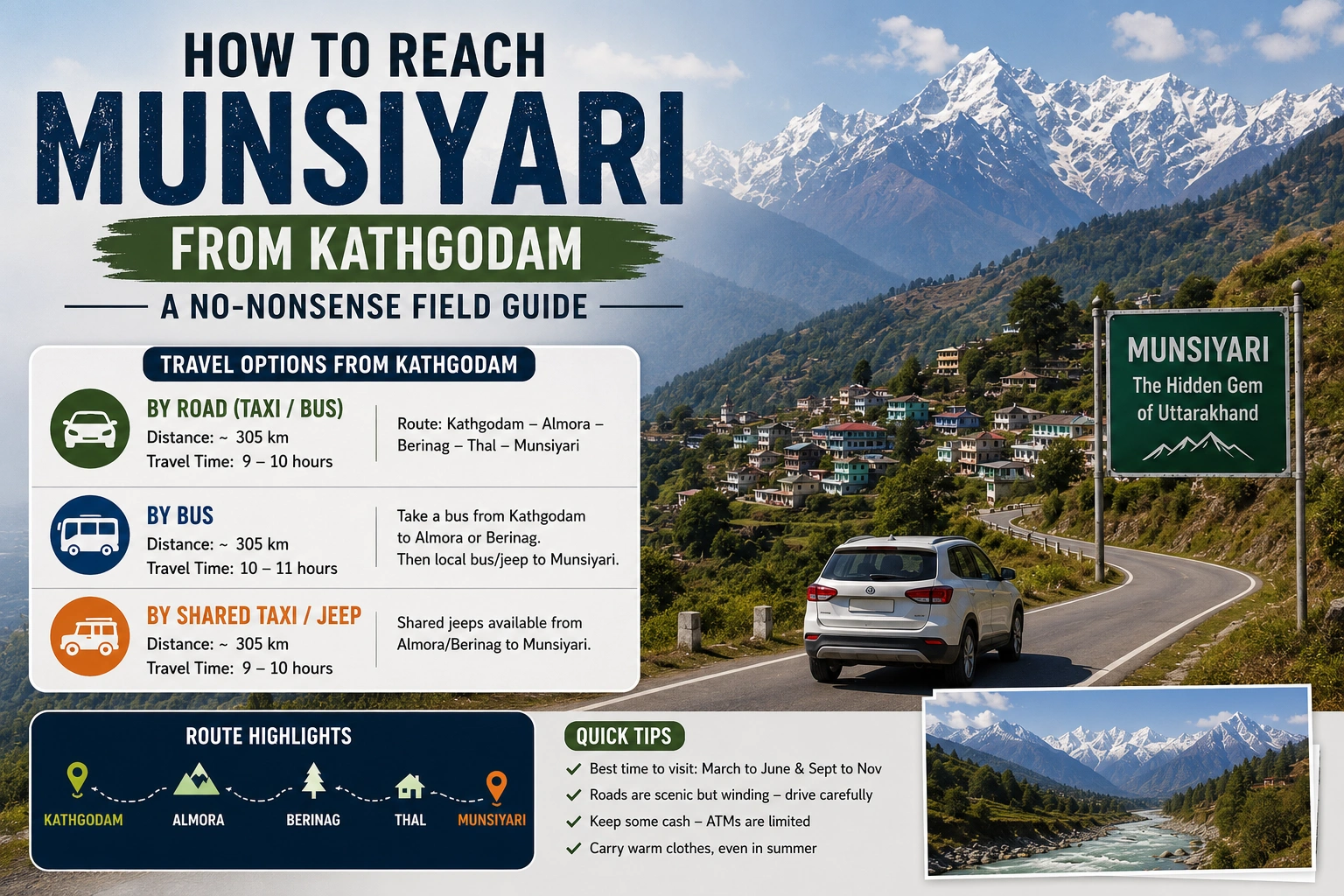
BlogThe distance from Kathgodam to Munsiyari is approximately 295–305 km by road, and the journey takes 10 to 13 hours depending on road conditions, the season, and where you stop. There is no direct train or flight; every route goes by road, with Kathgodam being the last major railhead you’ll use before entering the mountains.
Why This Route Is Not Like Other Hill Drives
Most people who get this route wrong do so because they plan it like a quick Nainital or Mussoorie trip. It isn’t. After Kathgodam, you’re entering the Kumaon Himalayas — progressively narrow roads, sharp hairpin bends beyond Almora, and stretches past Birthi Falls where the asphalt genuinely runs out in spots during monsoon. The drive is long, the road demands full concentration, and if you leave Kathgodam after 9 AM, you will either be driving in the dark through the Dharchula–Munsiyari stretch or spending an unplanned night at Thal or Birthi.
Plan your timing around daylight. That single decision changes everything.
Kathgodam to Munsiyari: The Route Breakdown
The standard road route from Kathgodam to Munsiyari follows this corridor:
Kathgodam → Bhimtal → Almora → Bageshwar → Thal → Birthi → Munsiyari
Total road distance: approximately 295–305 km Typical drive time: 10–13 hours (non-stop, good conditions)
This is not a highway drive. Beyond Almora, the road narrows considerably, and from Thal onwards — especially the 50 km stretch through Birthi Falls — it demands your full attention. Shared taxis and buses will take longer than private vehicles because of regular stops.
Stage 1: Kathgodam to Almora (90 km | ~2.5 hours)
This is the “easy” section. The road is relatively wider, well-maintained, and passes through Bhimtal if you want a brief stop. Almora is worth a 30-minute break for hot aloo ke gutke and chai before the harder stretch begins.
Local’s Tip: Don’t skip fuelling up your vehicle in Almora. Petrol pumps become unreliable and expensive beyond Bageshwar. Fill the tank full here — not “enough to reach the next town.”
Stage 2: Almora to Bageshwar (70 km | ~2 hours)
The road here winds through deodar forests and small villages. It’s slower but manageable. Bageshwar is your last proper town with ATMs that reliably work, a functioning hospital, and decent guesthouses if you need to break the journey overnight.
Common Mistake: Skipping Bageshwar ATMs. UPI and cards work inconsistently past this point. Carry at least ₹3,000–5,000 in cash for fuel, food, and emergency stays.
Stage 3: Bageshwar to Thal (55 km | ~1.5–2 hours)
This section runs along the Saryu River valley and includes some genuinely rough patches. The scenery shifts dramatically — you’re now deep in the inner valleys. Thal (not to be confused with other Thals) is a small market town that serves as a useful overnight stop if you’re behind schedule.
Stage 4: Thal to Munsiyari via Birthi (80 km | ~3–4 hours)
This is the hardest and most rewarding section. The road climbs sharply, and the Birthi Falls area — especially during and just after monsoon — can see landslide debris or waterlogged patches. The final climb into Munsiyari sits at around 2,200 metres (7,200 feet). You will feel the altitude change if you’ve been at plains level.
Local’s Tip: If you reach Thal by 2 PM, continue to Munsiyari. If it’s past 3 PM, seriously consider staying the night at Thal. The final 80 km after dark on those roads is not worth the risk, especially if you’re not familiar with the terrain.
Transport Options: What Actually Works
Private Taxi or Self-Drive
The most practical and common choice for families or groups. A hired cab from Kathgodam costs roughly ₹5,000–7,000 for a one-way trip depending on vehicle type and negotiation. Bolero, Scorpio, or Innova are typical. Sedans are technically possible until Bageshwar but genuinely struggle on the final stretch.
Self-drive works well if you’re comfortable on mountain roads. A 4WD is not strictly required in dry conditions, but gives meaningful peace of mind post-monsoon.
Kathgodam to Munsiyari Bus
There is a direct KMOU (Kumaon Motor Owners’ Union) bus service that operates from Kathgodam to Munsiyari, though it runs on limited days and schedules shift seasonally. Journey time on the bus is typically 12–14 hours. The bus is not for those with motion sickness or lower-back issues — the road after Thal will test you on both counts.
Shared jeeps and taxis aggregate at the Haldwani/Kathgodam bus stand area and operate to Almora, Bageshwar, and Thal — you can stage your journey in sections this way if you prefer flexibility over speed.
Local’s Tip: For bus information, contact the Kathgodam KMOU bus stand directly — online schedules are often outdated or wrong. Call the stand or ask your hotel the night before.
Break the Journey in Two Days (Recommended for First-Timers)
Night 1: Kathgodam → Bageshwar (overnight stay) Night 2: Bageshwar → Munsiyari
This is genuinely the more sensible option if this is your first time on the route. You arrive in Munsiyari rested, in daylight, and with a proper meal in you — which matters more than you’d think at 2,200 metres. Bageshwar has decent guesthouses in the ₹800–1,500 range.
Seasonal Reality: When to Go and What Changes
The route from Kathgodam to Munsiyari behaves differently across the year. Here’s what that actually means:
March to June (Best Window) Roads are clear, weather is cold but stable in Munsiyari, and you get clean views of Panchachuli and the Milam Glacier direction. This is peak season — book guesthouses at least 2 weeks in advance in May. Road conditions from Kathgodam are good.
July to September (Monsoon — Proceed with Caution) The Birthi–Munsiyari stretch is prone to landslides. Roads may close without warning. If you’re driving yourself, check BRO (Border Roads Organisation) road status the morning you plan to cross Thal. Budget an extra buffer day in your itinerary. The journey is possible but unpredictable.
October to November (Second Best Window) Post-monsoon clarity gives some of the best Himalayan views of the year. Roads are drier, crowds are lower than summer, and temperatures in Munsiyari are cold but crisp rather than harsh.
December to February (Only for Prepared Travellers) Snow falls regularly in and around Munsiyari. The road from Thal to Munsiyari can get blocked. Only go if you have proper cold-weather gear, confirmed accommodation, and ideally a local contact. Not recommended for casual visitors.
Common Mistake: Going in October without checking Munsiyari’s accommodation availability. The post-monsoon window has grown popular and guesthouses fill up faster than people expect.
Permits and Documentation
As of 2025, Indian nationals do not require a permit to visit Munsiyari town itself. However, if you plan to trek further — toward Milam Glacier, Ralam, or Namsik — you will need Inner Line Permits (ILP), which are obtained from the District Magistrate’s office in Munsiyari or arranged through a registered local operator.
Foreign nationals require a Protected Area Permit (PAP), which needs advance arrangement. Carry a physical copy of your ID proof regardless — checkposts between Thal and Munsiyari do ask for it.
What to Carry That Most People Forget
After multiple trips on this route, the things that matter most are rarely the obvious ones:
- Medicines for motion sickness (mandatory for passengers, strongly advised for drivers)
- Physical cash — ₹3,000–5,000 minimum beyond Almora
- A printed/offline Google Maps download of the Bageshwar–Munsiyari stretch (network drops completely in several sections)
- Power bank: charging options are limited during stops
- A warm mid-layer even if you’re going in May — nights in Munsiyari are cold regardless of the calendar month
- Snacks from Almora or Bageshwar — roadside food beyond Thal is limited and unreliable
Quick Reference: Kathgodam to Munsiyari at a Glance
|
Detail |
Information |
|
Total Distance |
~295–305 km |
|
Total Drive Time |
10–13 hours |
|
Best Departure Time |
By 5–6 AM from Kathgodam |
|
Last ATM |
Bageshwar |
|
Last Petrol Pump |
Bageshwar (fill full) |
|
Overnight Break Point |
Bageshwar or Thal |
|
Best Season |
March–June, Oct–Nov |
|
Permits Required |
No (for town); ILP for treks |
|
Direct Bus Available |
Yes (KMOU, limited schedule) |
Frequently Asked Questions
Q: Which railway station is closest to Munsiyari?
Kathgodam Railway Station is the nearest railhead to Munsiyari, at approximately 295–305 km away. It is well-connected to Delhi, Lucknow, and other major cities. From Kathgodam, the rest of the journey to Munsiyari is entirely by road.
Q: Which month is best for Munsiyari?
April, May, and October are consistently the best months. April and May offer clear skies, open roads, and Panchachuli views without harsh cold. October brings post-monsoon clarity and fewer tourists. June is possible but marks the beginning of monsoon uncertainty. Avoid January and February unless you’re specifically seeking snow and are well-prepared.
Q: How far is Almora from Munsiyari?
Almora to Munsiyari is approximately 205–215 km by road, taking roughly 7–8 hours. The route goes via Bageshwar and Thal. Almora is a common secondary base for those coming from Kathgodam who prefer a staged journey.
Q: Which railway station is near to Munsiyari?
Kathgodam is the primary railway station used for Munsiyari. Tanakpur is another option for travellers coming from certain directions, though the road from Tanakpur to Munsiyari is longer and less frequently serviced by direct transport.
Q: How do I go to Munsiyari from Delhi?
The most practical route is Delhi → Kathgodam by overnight train (Ranikhet Express or Shatabdi to Moradabad + connection, or the Kathgodam Shatabdi from New Delhi) → road journey to Munsiyari. Total Delhi-to-Munsiyari time is roughly 18–22 hours including the train leg. Alternatively, drive from Delhi via NH9 to Moradabad, then Rampur, Rudrapur, and Kathgodam — total road distance around 530–550 km. Flying to Pantnagar Airport (Pant Nagar) cuts the rail


